
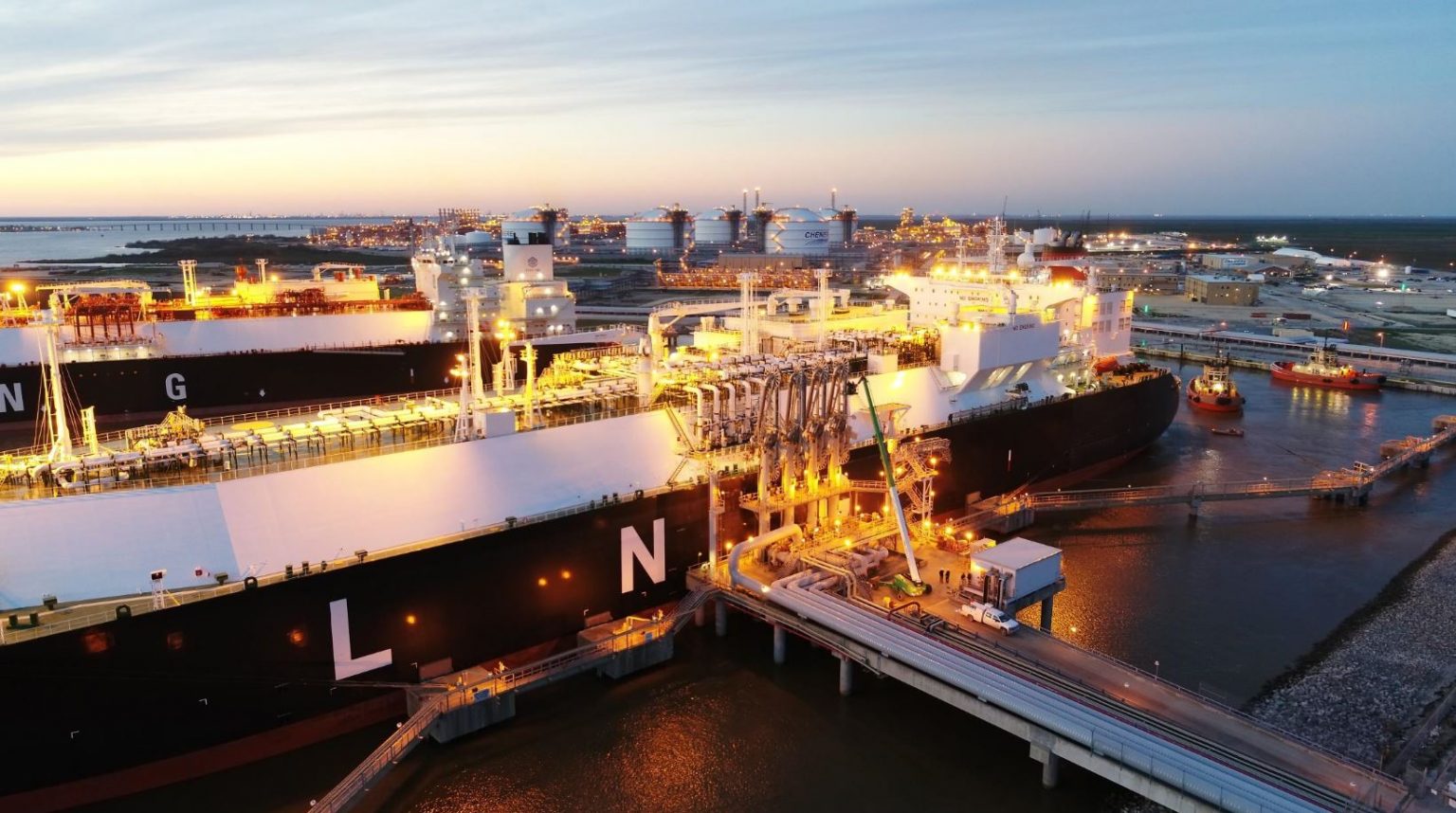
US liquefied natural gas (LNG) exports rose in the week ending March 13 compared to the week before, according to the Energy Information Administration.
The US EIA said in its weekly natural gas report that 26 LNG carriers departed the US plants between March 7 and March 13, three more compared to the week before.
Citing shipping data provided by Bloomberg Finance, the agency said the total capacity of these LNG vessels is 94 Bcf.
Natural gas deliveries to US terminals down 1.3 percent
Average natural gas deliveries to US LNG export terminals decreased by 1.3 percent (0.2 Bcf/d) week over week, averaging 13.3 Bcf/d, according to data from S&P Global Commodity Insights.
Natural gas deliveries to terminals in South Texas fell 10.2 percent (0.4 Bcf/d) to 3.1 Bcf/d, while natural gas deliveries to terminals in South Louisiana increased 1.9 percent (0.2 Bcf/d) to 8.9 Bcf/d.
The agency said that natural gas deliveries to terminals outside the Gulf Coast were flat week over week at 1.2 Bcf/d.
Cheniere’s Sabine Pass plant shipped nine cargoes and the company’s Corpus Christi facility sent four shipments during the week under review.
Sempra Infrastructure’s Cameron LNG terminal and the Freeport LNG terminal each shipped four cargoes during the period, while Venture Global’s Calcasieu Pass LNG terminal sent three cargoes.
Also, the Elba Island terminal sent two LNG cargoes and the Cove Point LNG terminal did not ship cargoes during the week under review.
One LNG vessel with a carrying capacity of 3 Bcf docked for off-loading at the Everett LNG terminal in Boston Harbor in Massachusetts between March 7 and March 13, it said.
Henry Hub down to $1.24/MMBtu
This report week, the Henry Hub spot price fell 42 cents from $1.66 per million British thermal units (MMBtu) last Wednesday to $1.24/MMBtu this Wednesday.
The agency said this is the lowest price in inflation-adjusted terms since at least 1997.
The price of the April 2024 NYMEX contract decreased 27.1 cents, from $1.929/MMBtu last Wednesday to $1.658/MMBtu this Wednesday.
Moreover, the price of the 12-month strip averaging April 2024 through March 2025 futures contracts declined 14.2 cents to $2.688/MMBtu.
TTF averaged $8.15/MMBtu
The agency said that international natural gas futures were mixed this report week.
Bloomberg Finance reported that weekly average front-month futures prices for LNG cargoes in East Asia increased 9 cents to a weekly average of $8.45/MMBtu.
Natural gas futures for delivery at the Dutch TTF decreased 23 cents to a weekly average of $8.15/MMBtu.
In the same week last year (week ending March 15, 2023), the prices were $14.22/MMBtu in East Asia and $14.57/MMBtu at TTF, the agency said.