
Golar LNG’s unit Macaw Energies will deploy its first small-scale liquefaction unit next month at a flare gas site in Texas for live testing and commercial use, according to Golar LNG’s CEO Karl Staubo.
Golar is now focused on FLNGs. However, it owns Macaw which is a small-scale LNG player with a land-based solution for capturing and monetization of flare gas, and it also has a 23.5 percent stake in shipowner Avenir LNG.
Staubo said during Golar’s first quarter earnings call on Tuesday that its unit Macaw has now successfully developed the pilot LNG production unit named F2X.
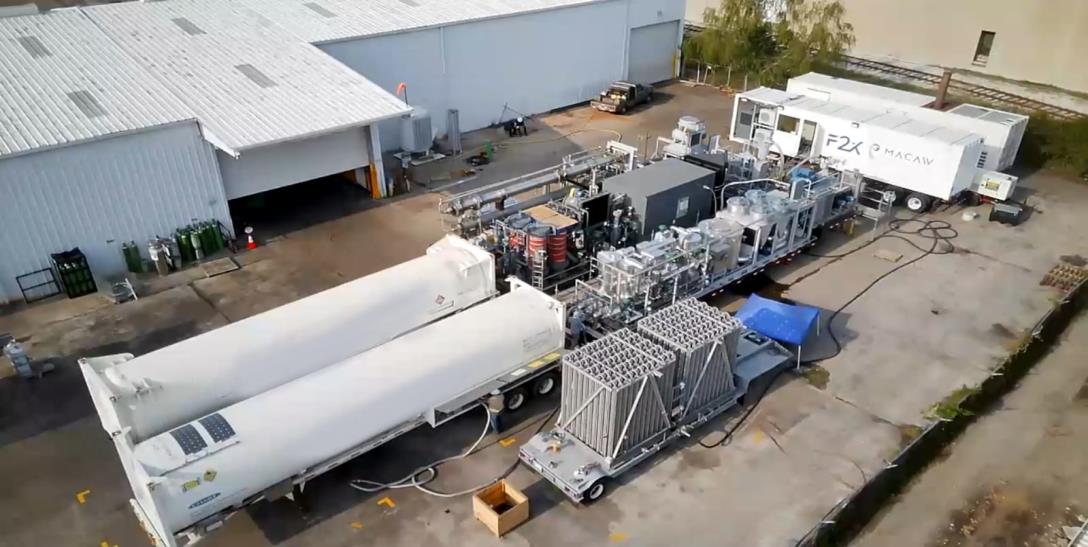
The F2X unit has already produced LNG during testing in April. The picture above shows the unit mounted outside of the factory in Texas where it was built.
“This is a modularized system that enables capturing and monetization of flare gas for land wealth, specifically targeting markets in the US, South America, and Middle East,” he said.
“We’re pleased to say that the first unit was delivered on time and budget and has proven to already produce LNG from natural gas inputs,” Staubo said.
The unit is currently being mobilized to a site in Texas for commercial demonstration of the technology, he said.
“Several large potential clients”
Golar’s quarterly presentation shows that it expects 20,000+ metric tons of CO2e reduction per year per unit from flare capture.
Also, one unit is able to produce about 700 MMbtu of LNG and about 500 MMbtu of NGLs per day.
In the US, Macaw signed GSAs with two “leading independent upstream players” with operations in Texas, the presentation shows.
“We see the business opportunity as very attractive time from CapEx to cash flow, we’re approximately 10 months to 12 months to build one unit,” Staubo said.
“Based on the current planned commercial model, we see a CapEx to Ebitda of around 3 times to 4 times based on the existing commercial opportunities that we have identified,” he said.
Staubo said that the company has “several large potential clients of Macaw and the F2X technology doing due diligence on the company, and some of them have expressed interest for off-take of multiple units.”
Once the Macaw technology is fully proven, Golar will consider to separate out Macaw in a standalone entity during 2024 to roll out the business model and build a portfolio of F2X units, he added.