
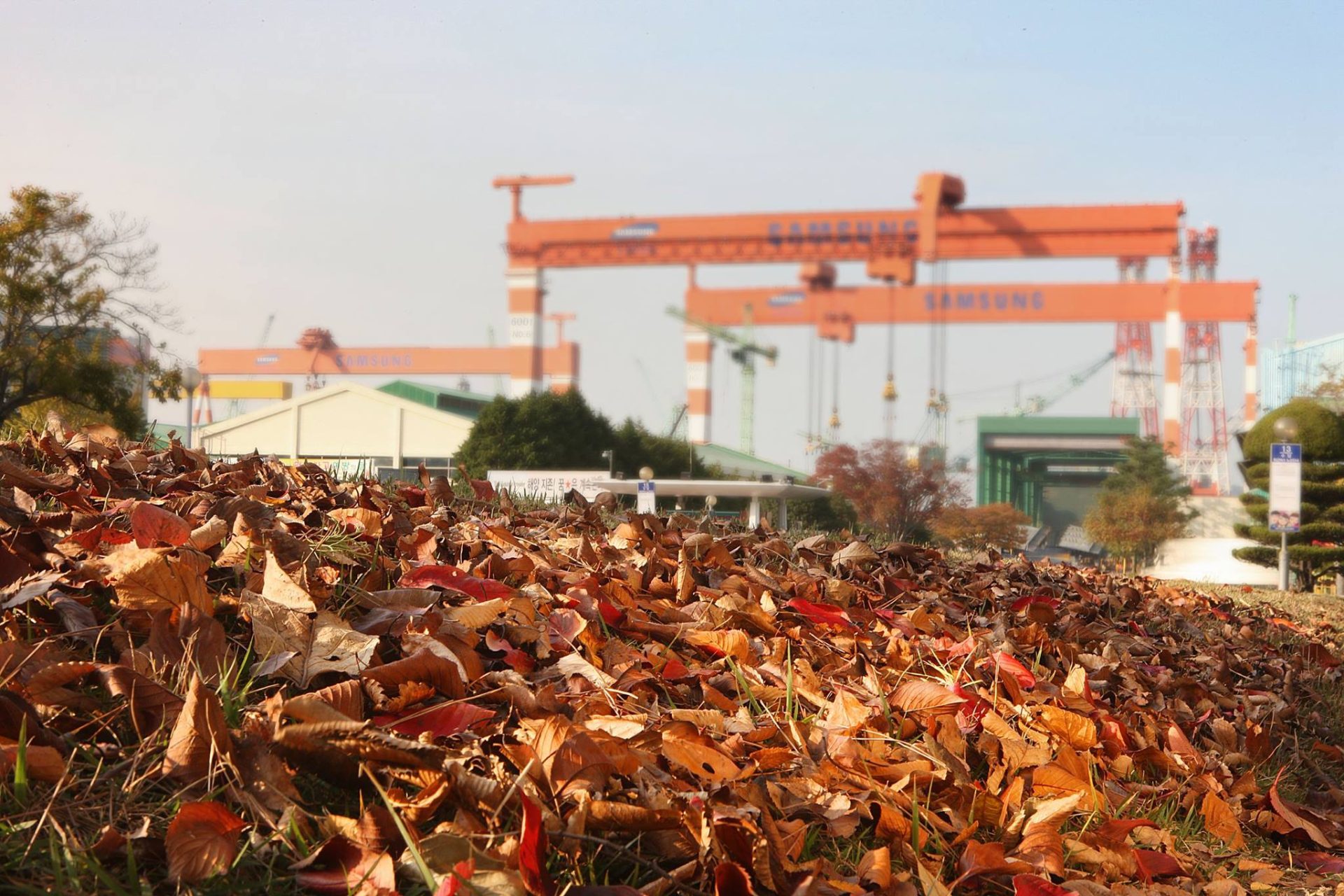
South Korean shipbuilding giant Samsung Heavy Industries said it will sue Russian shipbuilder Zvezda after the latter decided to terminate contracts for 10 ice-class Arc7 liquefied natural gas (LNG) carriers and seven shuttle tankers.
Back in November 2020, Zvezda awarded a contract to SHI worth about 2.8 trillion won ($2.04 billion) for the supply of blocks and equipment for 10 ice-class Arc7 carriers intended to serve the Novatek-operated Arctic LNG 2 project.
In October 2021, the duo signed another contract for the supply of blocks and equipment for seven icebreaking Arctic shuttle tankers worth about 2.04 trillion won ($1.48 billion).
SHI said in a filling with the stock exchange on Wednesday that both of these contracts were terminated by Zvezda, which claims that SHI had defaulted on the contract.
According to SHI, Zvezda unilaterally claimed contract default during negotiations and demanded termination notice and repayment of the advance payment of about $800 million plus delayed interest.
Sanctions
SHI explained that it had suspended work on the vessels during the design phase in February 2022 due to the sequential implementation of sanctions against Russia by the US government and the Korean government.
It notified Zvezda of force majeure while continuing to discuss the future implementation of these contracts.
During February and June this year, the US government designated the shipowner as a specially designated nationals and blocked persons, which resulted in a blockade of transactions with the shipowner and mutual negotiations on whether to continue the contract, SHI said.
SHI said that it is currently unable to conduct any financial transactions with Zvezda due to the sanctions.
The South Korean shipbuilder said it plans to file a lawsuit in the Singapore Arbitration Court to dispute the legality of the termination notice and the scope of the return, while continuing negotiations.
15 vessels
In September last year, Zvezda hosted a naming ceremony for the first of fifteen ice-class Arc7 carriers which will serve the Novatek-operated Arctic LNG 2 project.
The vessel in question is Sovcomflot’s 172,600-cbm Aleksey Kosygin. Prior to that, the shipbuilder launched the second and the third vessel. These hulls were built by SHI.
Zvezda officially started building the first vessel in this batch in November 2020.
Russia’s largest shipping firm Sovcomflot ordered this vessel directly at the compatriot yard.
Novatek, Sovcomflot, and VEB.RF finalized the construction and charter deals for the other 14 vessels with Zvezda in September 2020.
Additionally, Arctic LNG 2 entered into charter deals for the vessels with SMART LNG, a venture consisting of Novatek and Sovcomflot.
Besides SHI, Zvezda joined forces with French LNG containment giant GTT to build the Arc7 ice-breaking LNG carriers with GTT’s Mark III tech.
However, GTT ceased all of its activities in Russia following new EU sanctions against Russia and Russian companies, including the tank design of 15 ice-breaking LNG carriers under construction at Zvezda.
Arctic LNG 2
In August last year, Novatek completed the installation of the first gravity-based structure platform which will serve its Arctic LNG 2 project located on the Gydan peninsula.
According to reports in Russia, Novatek started production of LNG from this unit in December but it is not shipping LNG from the project due to sanctions and lack of vessels.
The first GBS, or train, has a capacity of about 6.6 mtpa, such as the the two other units which are under construction.
The resource base of the Arctic LNG 2 project is the Utrenneye field located on the Gydan Peninsula in the YaNAO, about 70 km from Novatek’s Yamal LNG project across the Gulf of Ob.
Novatek is the LNG project’s operator with a 60 percent stake, TotalEnergies owns 10 percent, while CNPC and CNOOC of China have 10 percent, each.
Japan Arctic LNG, a consortium of Mitsui & Co and Jogmec, owns a 10 percent stake in the project as well.
In January, TotalEnergies initiated a force majeure process on the Novatek-operated Arctic LNG 2 project in Russia due to sanctions.
In March 2022, TotalEnergies said it would no longer provide capital and book proven reserves for the Arctic LNG 2 project due to the uncertainty created by the technological and financial sanctions on the ability to carry out the development.
After that, TotalEnergies wrote down its 19.4 percent stake in Novatek and withdrew the representatives of the company from the board of Novatek.