This story requires a subscription
This includes a single user license.
The LNG terminal operator announced on Wednesday that “market participants can now apply to reserve up to 28 TWh per year for 8- or 12-year periods.”
The procedure starts today, and the closing date is scheduled for April 24, 2026.
As previously reported, KN announced in January that it had initiated a market-sounding process for regasification capacity.
European gas market “remains in a phase of transformation”
KN said long-term booking of regasification capacity provides market participants with an opportunity to secure strategic LNG supply positions in the region and to structure long-term LNG supply contracts.
Long-term capacity reservations also contribute to efficient utilisation of the terminal and competitive pricing, as higher infrastructure usage helps optimise maintenance costs for all users, the company said.
KN noted that the European gas market “remains in a phase of transformation: although price volatility and market tensions persist, long-term security of supply and access to reliable infrastructure remain among the key priorities of the energy sector.”
As regional gas trading expands and integration of the Baltic and Nordic gas markets strengthens, while supply opportunities beyond the region continue to develop, the Klaipėda LNG terminal is becoming an “increasingly important and strategic gateway” to the global LNG market, it said.
Fully booked until 2032
The terminal’s capacity is fully booked up to 2032.
In addition, part of the capacity for the period 2033–2044 has already been contracted.
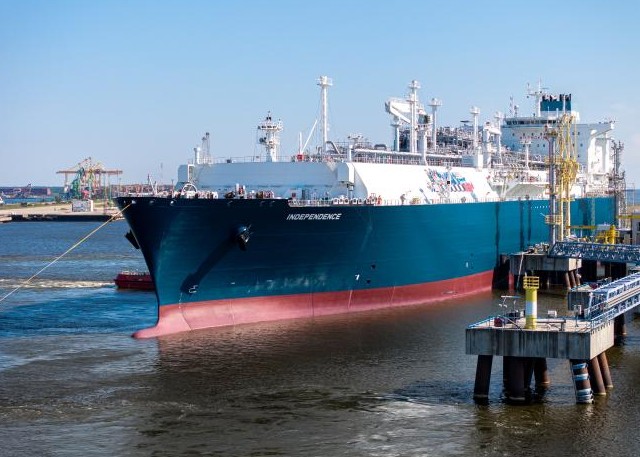
The Klaipeda FSRU-based LNG terminal currently provides regasification and reloading services, as well as biomethane liquefaction by equivalence.
In December 2024, KN Energies assumed ownership of the 170,000-cbm FSRU Independence from Hoegh Evi, and the unit was registered under the Lithuanian flag.
In March last year, the FSRU completed its 500th ship-to-ship LNG transfer in Klaipeda since the start of operations in 2014.
The majority of LNG volumes originate from Norway and the United States, but the Klaipeda FSRU-based facility has also received LNG from Nigeria, Trinidad and Tobago, Egypt, Algeria, and other countries.