This story requires a subscription
This includes a single user license.
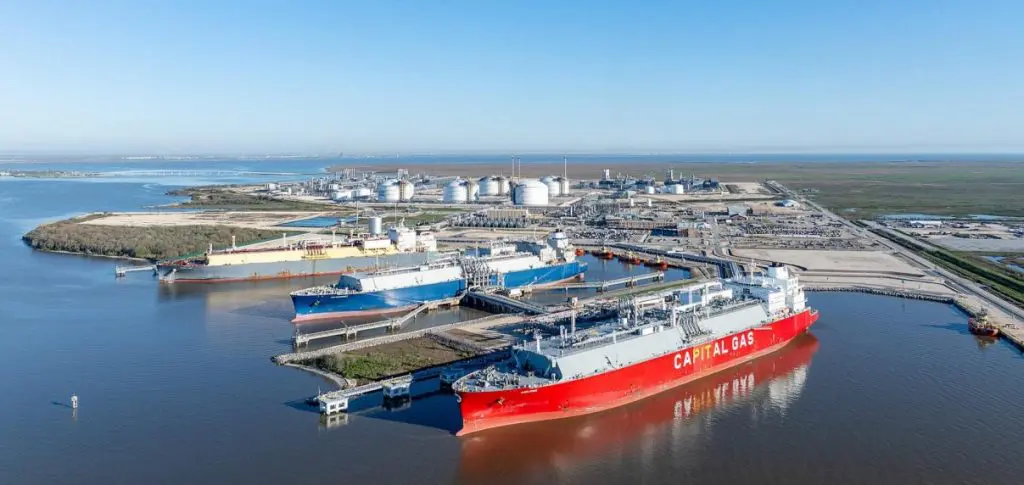
EIA said in its weekly natural gas storage report that the LNG-carrying capacity of vessels departing US ports was 134 Bcf, up 1 Bcf from the previous week.
Cheniere’s Sabine Pass plant shipped nine LNG cargoes, and the company’s Corpus Christi facility sent six shipments during the week ending April 22, according to the report.
Moreover, Venture Global LNG’s Plaquemines terminal sent seven cargoes, while the Freeport LNG facility and Sempra Infrastructure’s Cameron LNG terminal each shipped four cargoes.
Venture Global’s Calcasieu Pass facility shipped three cargoes, and the Cove Point facility and the Elba Island facility each sent one cargo during the week under review.
Henry Hub slightly up
EIA reported that the Henry Hub spot price rose by 1 cent from $2.75/MMBtu last Wednesday to $2.76/MMBtu this Wednesday.
The agency said that prices in April so far have averaged $2.82/MMBtu, down 17 percent from the April 2025 average.
Moreover, the Henry Hub price was the highest of major pricing hubs across the US on Wednesday.
Total domestic US demand for natural gas increased by 4 percent (2.3 Bcf/d) compared with last week, according to LSEG data.
A 10 percent (1.5 Bcf/d) increase in residential and commercial sector consumption drove this increase.
EIA said average total supply of natural gas fell 0.7 percent (0.9 Bcf/d) this week due to a 0.7 percent (0.8 Bcf/d) decrease in dry production.
US temperatures were near normal this past week, with averages ranging between 40°F and 80°F, the agency said.
TTF averaged $14.27/MMBtu
EIA said that the price at the Dutch Title Transfer Facility in Europe averaged $14.27/MMBtu, 96 cents lower than the previous week.
Moreover, the Japan-Korea Marker price averaged $15.66/MMBtu, $3.72 lower than the previous week.
This week’s JKM and TTF prices were 48 percent and 33 percent higher, respectively, than prices for the week ending February 25, the last full week before the disruption of LNG deliveries through the Strait of Hormuz, EIA said.