This story requires a subscription
This includes a single user license.
Cheniere said on Thursday that net income declined by $3.9 billion during the three months ended March 31, as compared to the same period in 2025.
This was primarily due to $4.8 billion of unfavorable changes in the fair value of agreements accounted for as derivative instruments (before tax and the impact of NCI), largely associated with the company’s long-term IPM (integrated production marketing) agreements.
According to Cheniere, these increased losses were primarily attributable to widening spreads between global and US domestic natural gas benchmarks and elevated global natural gas price volatility influenced in part by the tightening supply conditions, transit constraints, and heightened geopolitical uncertainties from the Middle East conflict and instabilities across parts of the Middle East during 2026.
Partially offsetting these losses was $462 million of favorable change in income tax provision (benefit), the recognition of $370 million in tax credits, and a $225 million decrease in net income attributable to NCI, Cheniere said.
Revenues and operating costs climb
On the other hand, the $424 million increase in total revenues was primarily attributable to $1.3 billion increase primarily due to higher pricing per MMBtu from increased Henry Hub pricing, to which the majority of Cheniere’s long-term LNG sales contracts are indexed, as well as higher volumes of LNG delivered as LNG revenues between the periods.
Cheniere said this was partially offset by $952 million of unfavorable changes in the fair value of agreements accounted for as derivative instruments included in revenues.
Cheniere’s operating costs surged to $9.36 billion in the first quarter from $4.48 billion in the comparable quarter last year.
Cheniere attributed the increase in total operating costs and expenses to $4.2 billion of unfavorable changes in the fair value of agreements accounted for as derivative instruments included in cost of sales indexed to global natural gas and LNG prices, and a $1.2 billion increase in the cost of natural gas feedstock, largely due to the increase in US natural gas prices and increased volume of LNG delivered.
The company said its total loaded volumes reached 688 TBtu in the first quarter, up 23 percent from the same quarter last year.
Cheniere loaded 187 LNG cargoes, a rise of 11 percent year-on-year.
The company reported consolidated Adjusted Ebitda of $2.33 billion.
This marks a 25 percent year-on-year increase due to higher total margins on LNG delivered, primarily driven by higher volumes and contributions from optimization activities, in addition to the recognition of a nonrecurring tax credit during the 2026 period, Cheniere said.
Cheniere raised full-year 2026 consolidated Adjusted Ebitda guidance from $6.75 billion – $7.25 billion to $7.25 billion – $7.75 billion and full-year 2026 distributable cash flow guidance from $4.35 billion – $4.85 billion to $4.75 billion – $5.25 billion.
First LNG production from sixth Corpus Christi expansion train
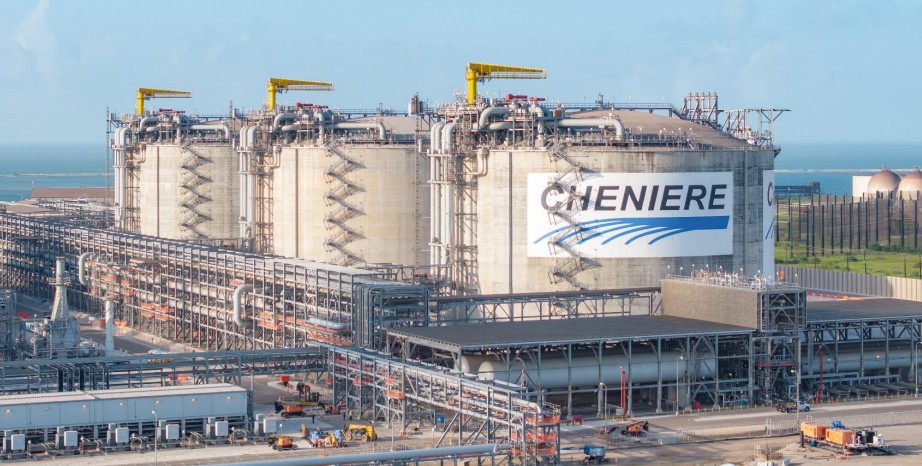
Cheniere also said that first LNG production from the sixth train of the CCL Stage 3 Project is expected “imminently.”
The company’s unit Corpus Christi Liquefaction, submitted a request to US FERC on Wednesday, seeking approval to introduce feed gas and refrigerants to the cold end of Midscale Train 6 (String 2).
In March 2025, Cheniere achieved substantial completion of the first liquefaction train at the Corpus Christi Stage 3 expansion project, while the company completed the second liquefaction train in August, the third train in October, the fourth train in December, and the fifth train in March this year.
“We are raising our 2026 financial guidance as a result of an increase in our LNG production forecast and higher market margins for the year, as well as the contribution from optimization activities achieved year-to-date,” said Jack Fusco, Cheniere’s president and CEO.
“The elevated volatility in global energy markets today further signals the need for additional investment in reliable, secure LNG capacity. We look forward to advancing accretive, brownfield growth at Sabine Pass and Corpus Christi, as we continue to create long-term sustainable value for shareholders,” he said.