This story requires a subscription
This includes a single user license.
Preliminary bunkering data on MPA’s website shows LNG bunkering sales in the world’s largest bunkering port reached 42,430 mt last month.
This compares to 42,000 mt in April 2025.
LNG bunkering sales dropped from 49,020 mt in March, 59,010 mt in February, and were similar compared to 42,590 mt in January.
During the first four months of this year, Singapore LNG bunkering volumes rose 34.2 percent year-on-year to 193,050 mt.
Last year, Singapore LNG bunkering volumes rose 23.9 percent compared to the year before, reaching a new yearly record.
Data on MPA’s website shows LNG bunkering sales reached 571,350 mt last year.
This compares to 460,950 mt in 2024, which surged compared to 110,850 mt in 2023.
LNG bunkering volumes in Singapore increased due to new bunkering vessels working in the Singapore port, the growth of the global fleet of LNG-powered vessels, and lower LNG fuel prices.
However, LNG prices surged in March following the closure of QatarEnergy’s giant Ras Laffan LNG facility due to missile attacks and the closure of the Strait of Hormuz.
The small growth in April LNG bunkering volumes could be related to market disruption, but a larger impact on the LNG fuel market in Singapore has not yet been seen.
Scaling up LNG fuel use
MPA is also currently looking for ways to scale up the use of LNG as a marine fuel in the port of Singapore.
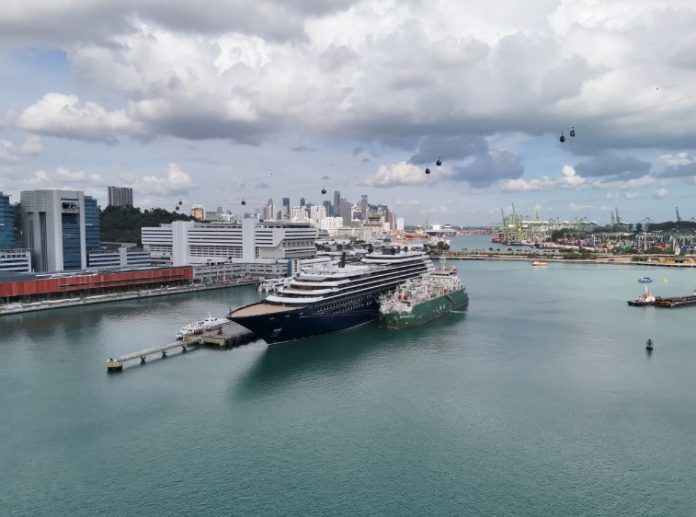
At present, the port of Singapore is served by three licensed LNG bunker suppliers and hosts three LNG bunkering vessels which provide ship-to-ship fueling operations.
The bunkering vessels are the 7,500-cbm FueLNG Bellina, the 18,000-cbm FueLNG Venosa, and the 12,000-cbm Brassavola.
In January, MPA opened applications for additional licenses to supply LNG as a marine fuel in the port of Singapore.
According to MPA, the license application is open to both existing LNG licensees and new entrants.