This story requires a subscription
This includes a single user license.
Luca Passa, Snam’s chief of financial sustainability and international asset management officer, said during Snam’s first-quarter earnings call last week that LNG continues to “provide significant volumes and flexibility, accounting for around 33 percent of total gas imports, with 52 cargoes delivered to Italy versus 45 last year.”
In the January-March period, Italian gas demand amounted to 21.8 bcm.
He said the 0.5 percent increase year-on-year was mainly driven by the thermal electric sector, partially offsetting lower hydroelectric generation.
Passa noted that Italian gas export was “stable” at approximately 0.5 bcm, mainly through Tarvisio.
LNG volumes
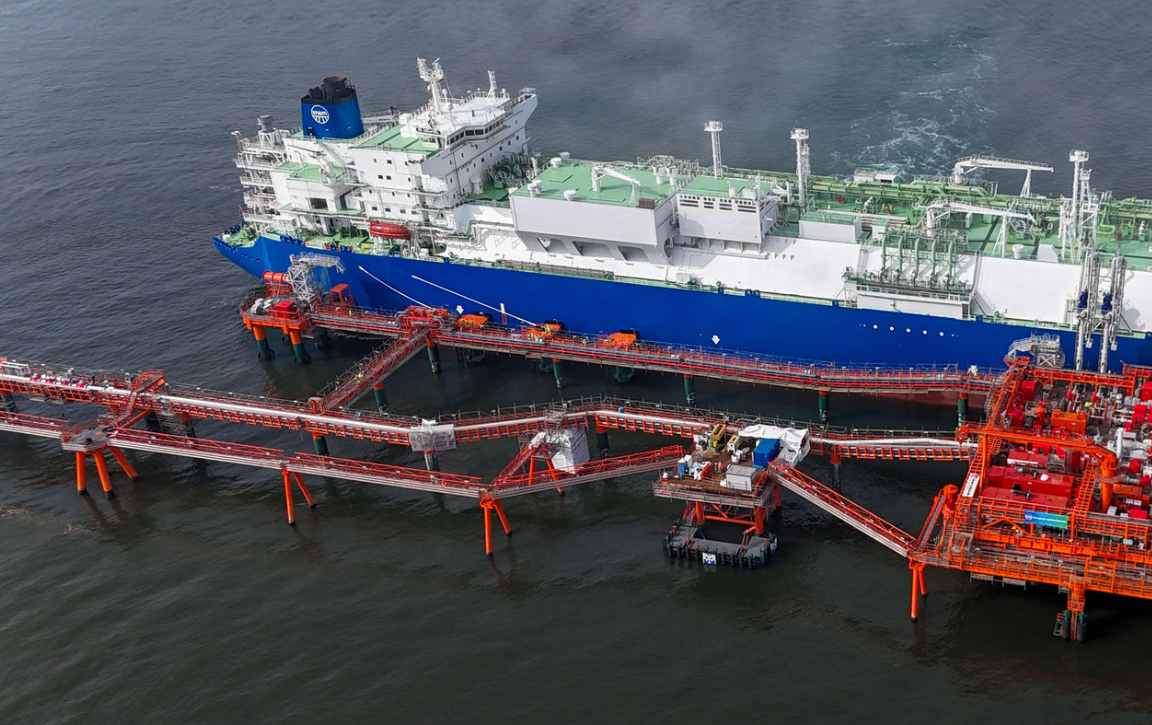
“Looking at the supply flows, we have seen a further increase with LNG volumes up 17 percent versus the first quarter of 2025, mainly driven by the good availability of the Ravenna FSRU, which has been fully operational since May 2025,” he said.
Passa said the additional LNG capacity is “significantly enhancing the country’s energy security by diversifying supply sources, which is particularly important in the current geopolitical environment.”
LNG volumes reached 5.3 Bcm in the first quarter, up from 4.53 Bcm in the previous year.
Adriatic LNG volumes increased 2.5 percent year-on-year to 2.32 Bcm, OLT Offshore volumes increased 3.7 percent to 1.12 Bcm, Piombino FSRU volumes increased 5.6 percent to 1.11 Bcm, Ravenna FSRU volumes reached 0.63 Bcm, while Panigaglia LNG volumes dropped 2.2 percent to 0.13 Bcm.
Snam recently became the sole owner of OLT Offshore LNG Toscana, the operator of the FSRU Toscana offshore Livorno, after it agreed to purchase the remaining 2.69 percent share in OLT from Golar.
In addition to OLT, Snam holds controlling or co-controlling stakes in all regulated LNG regasification terminals operating in Italy.
These include the Panigaglia onshore terminal (100 percent stake), operating since 1971 near La Spezia, the Adriatic LNG terminal (30 percent stake), operating since 2009 offshore Rovigo, the Italis FSRU (100 percent stake), operating since July 2023 offshore Piombino, and the BW Singapore FSRU (100 percent stake), operating since May 2025 offshore Ravenna.
Qatari force majeure
Passa also mentioned the QatarEnergy force majeure, which was declared in March following missile attacks on the giant Ras Laffan LNG complex.
Italian energy firm Edison, a unit of EDF, recently said it had received a new force majeure notification from state-owned LNG giant QatarEnergy, affecting supplies scheduled for delivery at the Adriatic LNG terminal in Italy.
“The notice concerns an additional 2 LNG cargoes scheduled for delivery to Italy up to early July, on top of the 10 LNG cargoes already covered by the previous communications,” Edison said in a statement.
Passa said that in Italy, “we have not observed any physical disruption to the gas flows with all expected cargoes in March delivered as planned.”
“In April, Qatari volumes affected by the force majeure were effectively replaced by cargoes from alternative geographies,” he said.
Passa said that Europe has experienced “limited physical tightness so far, supported by weaker weather-driven demand in March and April, as well as reduced competition from Asia.”
“Storage refilling remains as a key European theme looking ahead, in this context, we have proactively accelerated the injection into our storage facilities, securing the volumes required for the next winter season,” Passa said.
“As a result, by the end of April, storage levels reached around 50 percent of available capacity, today at 53 percent, compared with a European average of approximately 33 percent, which also includes Italy,” he said.