This story requires a subscription
This includes a single user license.
A Gasunie spokeswoman told LNG Prime on Thursday that this is an assessment required by the European Union and the Dutch consumer protection regulator ACM.
The survey, which was not created by Gate and EemsEnergyTerminal, provides the terminals with “more insight into the market demand for sustainable carriers,” she said.
Gate
Gate, located in the Dutch port of Rotterdam, launched its assessment in March, giving companies until April 3 to submit their responses.
“In line with Article 9 of the European Gas and Hydrogen Regulation (EU 2024/1789), Gate terminal must conduct a market-demand assessment in our facility every two years for investments allowing the use of renewable gas and low-carbon gas, including hydrogen compounds, such as liquid ammonia and liquid organic hydrogen carriers,” the LNG terminal operator said.
“The objective of this market-demand assessment is to gain deeper insights into your ambitions and forthcoming strategy in relation to the possible supply of renewable energy sources and possible transition paths,” it said.
Gate added that it will use this information to inform the relevant regulatory authorities on the outcome of this market demand assessment.
In August 2023, Gasunie and Vopak took FID to build the fourth storage tank and add more regasification capacity at the Gate LNG terminal.
The expansion, which costs approximately 350 million euros ($406 million), consists of a new 180,000-cbm LNG storage tank, expected to enter service this year, and additional regasification capacity of 4 Bcm per year.
Gasunie and Vopak also recently took a final investment decision to build the fourth jetty at Gate. The new jetty will serve the LNG bunkering market.
Eemshaven LNG
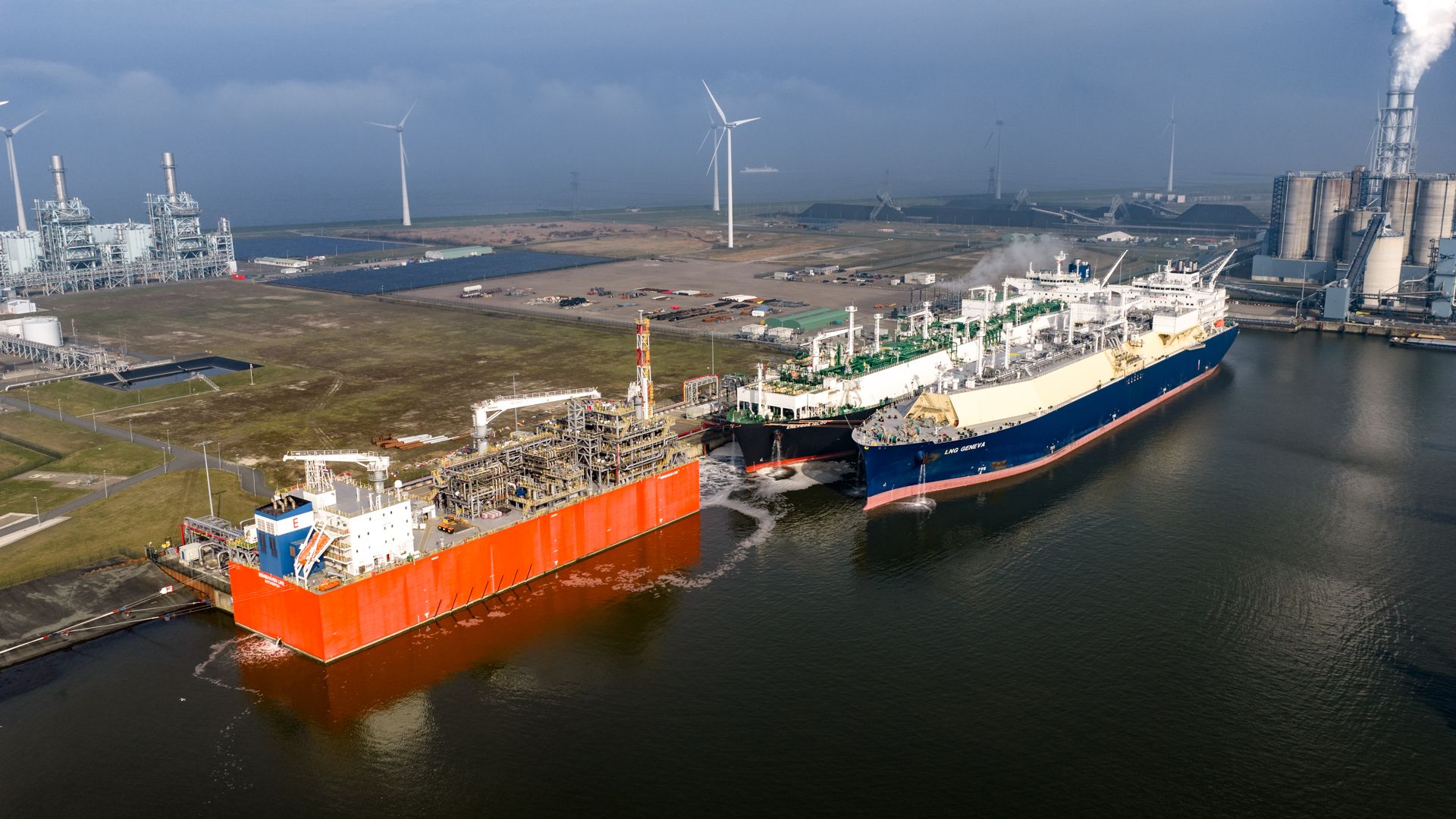
As per the Eemshaven LNG terminal, which consists of two chartered floating storage and regasification units (FSRUs), EemsEnergyTerminal is still conducting its market assessment.
The assessment will be open for input until May 31.
EemsEnergyTerminal’s assessment includes questions about the role of bio-LNG and e-LNG (synthetic LNG), as well as hydrogen (ammonia) imports.
In March this year, the FSRU-based LNG import facility received its 200th shipment since its launch in September 2022.
The Eemshaven LNG hub currently consists of two chartered FSRUs– the 170,000-cbm FSRU Energos Igloo, owned by Energos Infrastructure, and the 26,000-cbm barge-based FSRU Eemshaven LNG, owned by Exmar.
It is the first FSRU-based terminal in the Netherlands and the second LNG import terminal in the country after Gate.