This story requires a subscription
This includes a single user license.
Last month, Ingintis reserved 4 TWh of annual regasification capacity for 2033–2044 through the long-term capacity allocation procedure organized by LNG terminal operator KN Energies.
Ignitis announced in a statement on Wendesday that it has additionally secured 2 TWh of annual regasification capacity on the secondary market for the period of 2033–2044.
“Long-term access to the terminal provides greater flexibility in planning gas supplies, enables the diversification of supply sources, and strengthens energy resilience in Lithuania and the Baltic region,” Ignitis said.
Besides Ignitis, Finland’s Gasum, Ukraine’s Naftogaz, Latvia’s Latvenergo, and Norway’s Equinor also booked long-term regasification capacities last month.
During the allocation procedure, the majority of the offered capacities were allocated – more than 20 terawatt-hours (TWh): 8 TWh until 2044 inclusive and a further 12 TWh until 2040, according to KN.
Taking into account the results of this procedure, as well as the 4 TWh package of long-term capacities until 2044 allocated back in 2023, the total utilization of the LNG terminal will reach around 75 percent of the terminal’s nominal capacity, KN said.
KN recently also launched a regasification capacity allocation procedure for 2027.
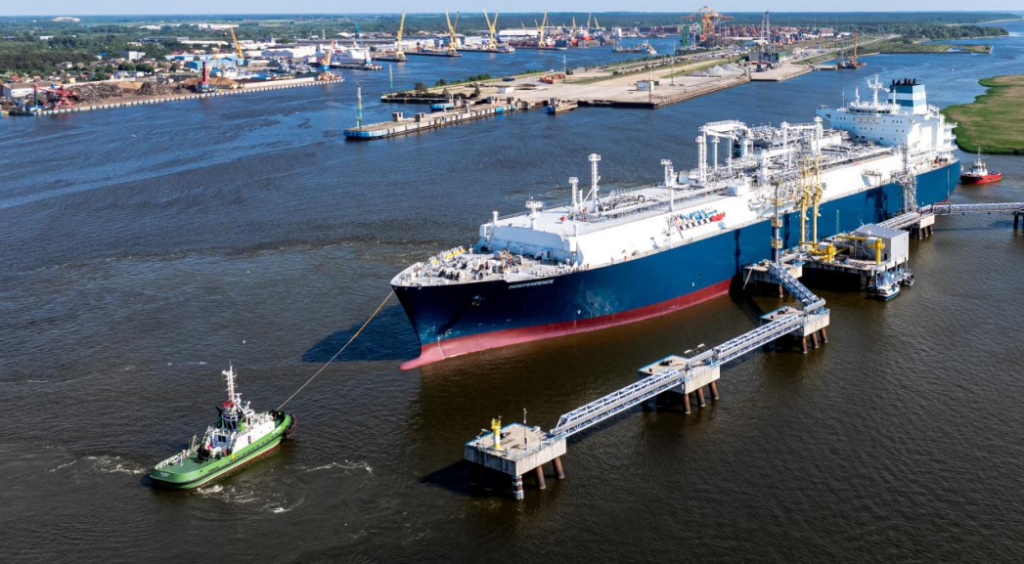
In December 2024, KN assumed ownership of the 170,000-cbm FSRU Independence from Hoegh Evi, and the unit was registered under the Lithuanian flag.
In March last year, the FSRU completed its 500th ship-to-ship LNG transfer in Klaipeda since the start of operations in 2014.
The majority of LNG volumes originate from Norway and the United States, but the Klaipeda FSRU-based facility has also received LNG from Nigeria, Trinidad and Tobago, Egypt, Algeria, and other countries.