
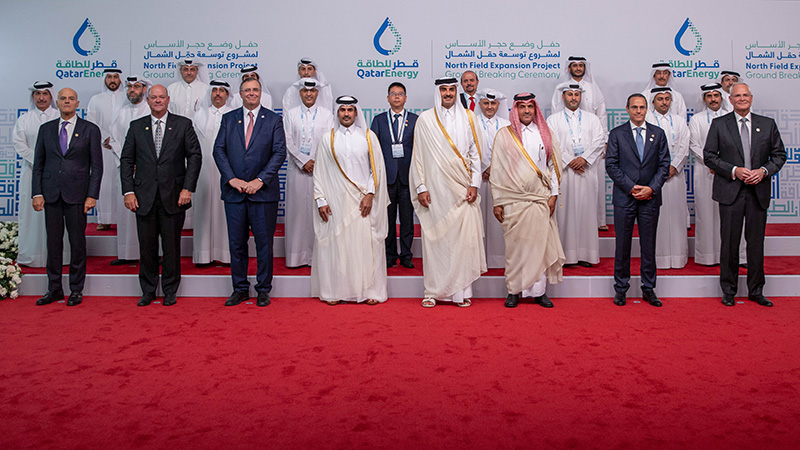
State-owned LNG giant QatarEnergy has officially started building its North Field expansion project, which will raise Qatar’s LNG production capacity to 126 Mtpa by 2026.
The project’s ground breaking took place during a special ceremony on Tuesday at Ras Laffan attended by Qatar’s energy minister and chief executive of QatarEnergy, Saad Sherida Al-Kaabi, and the CEOs and senior executives of QatarEnergy’s partners in the expansion project.
QatarEnergy’s partners in the project are Shell, ConocoPhillips, ExxonMobil, TotalEnergies, Eni, Sinopec, and CNPC.
The project includes six mega trains, each with a production capacity of eight Mtpa of LNG, four of which are part of the North Field East expansion project, and two are part of the North Field South expansion project.
In addition to 48 Mtpa of LNG, the project will produce 6,500 tons per day of ethane gas, which will be used as a feedstock in the local petrochemical industries.
The project will also produce about 200,000 barrels per day of liquefied petroleum gas (propane and butane), and about 450,000 barrels per day of condensates, in addition to large quantities of helium and pure sulfur.
Technip and Chiyoda won the EPC award for the North Field East project, while QatarEnergy awarded the contract for the North Field South project to a joint venture of Technip Energies and Consolidated Contractors Company.
QatarEnergy LNG, previously known as Qatargas, currently operates 14 LNG production trains with a capacity of about 77 Mtpa in Ras Laffan.
“Quantum leap”
Speaking at the ground breaking ceremony, Al-Kaabi said that this “pioneering expansion project is a quantum leap in our country’s leadership in the field of energy.”
“This major expansion comes at a crucial time, as natural gas occupies a pivotal position in the energy mix in a world facing geopolitical turbulences and is in dire need of clean energy sources that are in line with the global environmental goals,” he said.
Last week, QatarEnergy also signed a shipbuilding deal worth about $3.9 billion with South Korea’s HD Hyundai Heavy Industries for the construction of 17 174,000-cbm LNG carriers.
The contract marked the start of the second phase of QatarEnergy’s giant LNG ship acquisition program.
Under the first phase, QatarEnergy contracted 60 LNG carriers at South Korea’s three shipbuilders HHI, SHI, and Hanwha Ocean, and China’s Hudong-Zhonghua.
The new deal brings the total number of confirmed new LNG vessels to be delivered to QatarEnergy and its affiliates to 77, with more to follow, QatarEnergy said.