This story requires a subscription
This includes a single user license.
In October last year, Jera’s unit signed a strategic partnering agreement with the government of Hawaii to support the US island state’s plans to shift away from oil by using alternative fuels, including natural gas.
Building on this agreement, Jera shared its proposal with the state of Hawaii on Tuesday to modernize Oahu’s energy system
Developed with input from Hawaii energy stakeholders and supported by agreements with local partners, the proposal seeks to a”ccelerate the replacement of aging, inefficient oil-fired generation on Oahu with modern, high-efficiency infrastructure designed to deliver affordability for Hawaii families and businesses, enhance energy grid resilience and lower emissions,” Jera said.
$2 billion
Jera said the Hawaii State Energy Office’s alternative fuel, repowering and energy transition study estimates that approximately $2 billion will be required to upgrade Oahu’s aging thermal infrastructure with more efficient equipment and lower-carbon fuel sources.
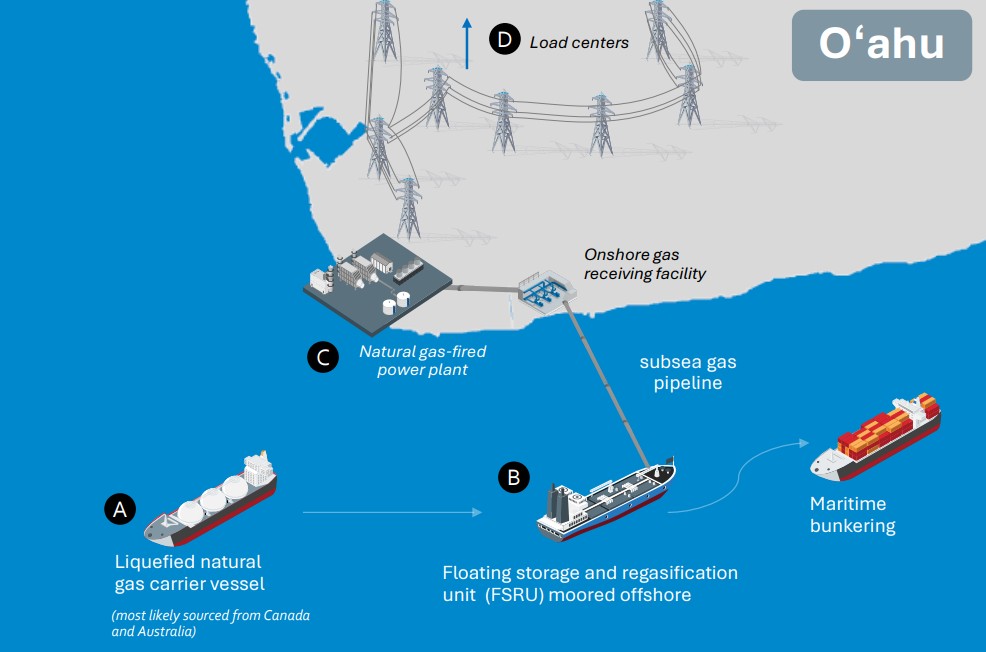
Consistent with that analysis, JERA’s proposal outlines how new energy assets could be developed on Oahu, including a 500-megawatt hybrid combined-cycle and simple-cycle power facility, supported by offshore LNG import infrastructure.
Jera said the proposed facility would be designed with modern turbine technology that improves system stability and operational performance.
It is expected to “significantly reduce the generation cost of electricity compared to today’s oil-based power, while improving grid reliability and reducing overall greenhouse gas emissions.”
“The proposed facility’s fast-start and fast-ramp capability is highly responsive to changing grid conditions, which will enable greater integration of renewables on Oahu,” Jera said.
Jera noted ir brings deep global expertise in high-efficiency combined-cycle gas turbine (CCGT) development, demonstrated through the modernization and construction of multi-gigawatt LNG-fired power plants in Japan and internationally.
In the US, JERA owns or has partial ownership in 10 power facilities.
Power plant and FSRU
Jera said that approximately 75 percent of the investment is related to the new power plant — infrastructure that would be required to replace aging generation and maintain grid reliability regardless of fuel source.
The remaining 25 percent is related to LNG-related infrastructure, including a floating storage and regasification unit (FSRU) and associated supply components.
Jera noted that the FSRU would likely receive LNG supples from Canada and Australia.
It can also supply the maritime industry with LNG bunkering fuel, it said.
Overall, more than 90 percent of the investment would be directed toward assets with long-term use or redeployment potential — including turbine equipment, grid-supporting infrastructure, pipelines and the FSRU — helping minimize stranded asset risk while maintaining flexibility for the future, according to Jera.
2030
Jera is exploring opportunities to participate in the equity investment and to help mobilize additional capital to support the development of the proposed infrastructure.
The company has partnered with local companies, including Hawaii Gas, Pasha Hawaii and others to advance a coordinated modernization of energy and maritime infrastructure across ʻahu.
Jera said the project is expected to support more than 1,100 skilled jobs and generate an estimated $150 million for Hawaii’s economy.
The project would require approval by the Hawaii Public Utilities Commission and other state and federal agencies.
Jera anticipates initiating required state and federal permitting processes in the coming months, including potential filings with the Federal Energy Regulatory Commission (FERC) and the City and County of Honolulu, subject to final regulatory determinations.
If approved, the new infrastructure would be developed over the next several years, with a target commercial operation date in 2030, Jera said.