This story requires a subscription
This includes a single user license.
According to its application filed with DOE on May 13, Power LNG seeks authorization to export the equivalent of approximately 51.75 billion cubic feet (Bcf) of LNG per annum for a term ending on December 31, 2050, with a three-year make-up period.
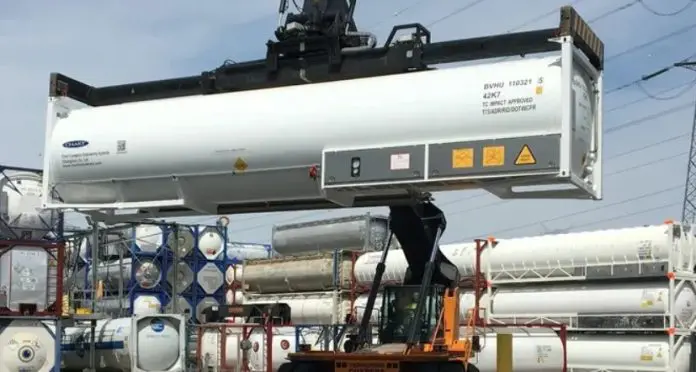
Power will export LNG using Department of Transportation-approved international organization for standardization (ISO) containers via ocean-going carrier from its proposed liquefaction and export facility located on Pelican Island within the port of Galveston to any country with which the US currently has, or in the future enters into, an FTA requiring national treatment for trade in natural gas.
The company noted that it currently holds a long-term FTA export authorization issued in 2023.
This application is intended to supersede and replace that authorization in its entirety, according to Power LNG.
Under the previous authorization, Power LNG was granted approval to export domestically produced LNG in a volume equivalent to 7.0445 Bcf/yr of natural gas for a term ending on December 31, 2050.
Power LNG said last year that it expects to complete front-end engineering and design (FEED) for its proposed LNG facility in 2025.
“We expect to reach a final investment decision (FID) by the end of Q4 2025,” the company said in its semi-annual progress report update filed with FERC in April 2025.
ISO containers
According to Power LNG, its facility is designed for multiple modular liquefaction trains, each capable of producing approximately 13 Bcf per year of LNG, for a combined nameplate capacity of approximately 51.75 Bcf per year at full build-out.
Phase I operations are anticipated to include the installation of an initial modular liquefaction train or trains sufficient to achieve Phase I production capacity of approximately 400,000 gallons of LNG per day (approximately 12 Bcf per year).
The facility is also designed to store up to 50 stacked ISO containers during Phase I, with ISO container storage capacity scalable as the facility expands through successive phases, consistent with final engineering, site layout, and applicable regulatory requirements.
The facility will include a dedicated truck loading facility designed to support the loading of LNG into ISO containers for transport to the marine berth within the port.
In addition, the facility will include the construction of a dedicated marine berth or the utilization of existing port berth infrastructure to support ISO container loading onto ocean-going vessels.
The company also noted that it intends to enter into a long-term natural gas supply agreement with Energy Transfer for delivery of natural gas from the HPL system to its proposed liquefaction and export facility.
Power LNG anticipates that the timing for completion of Phase I will be approximately twenty-four months from the date on which the company receives final approval of all regulatory authorizations required to commence construction.
Merger with United Energy LNG
In July last year, Power LNG also announced it had signed a merger agreement with United Energy LNG, a wholly owned subsidiary of United Energy, creating a scalable small-scale LNG platform serving industrial, power, and transport markets across North America.
According to a joint statement, the combined entity, operating under United Energy LNG (UE LNG), oversees a portfolio of three LNG production sites in “advanced stages” of development.
UE LNG announced at the time the commencement of front-end čoading Phase 1 (FEL-1) at its first project site in Houston, Texas, with a “second confidential site underway.”
A third site in Independence, Kansas “is scheduled to begin FEL-1 later this month,” the two firms said in the statement.