
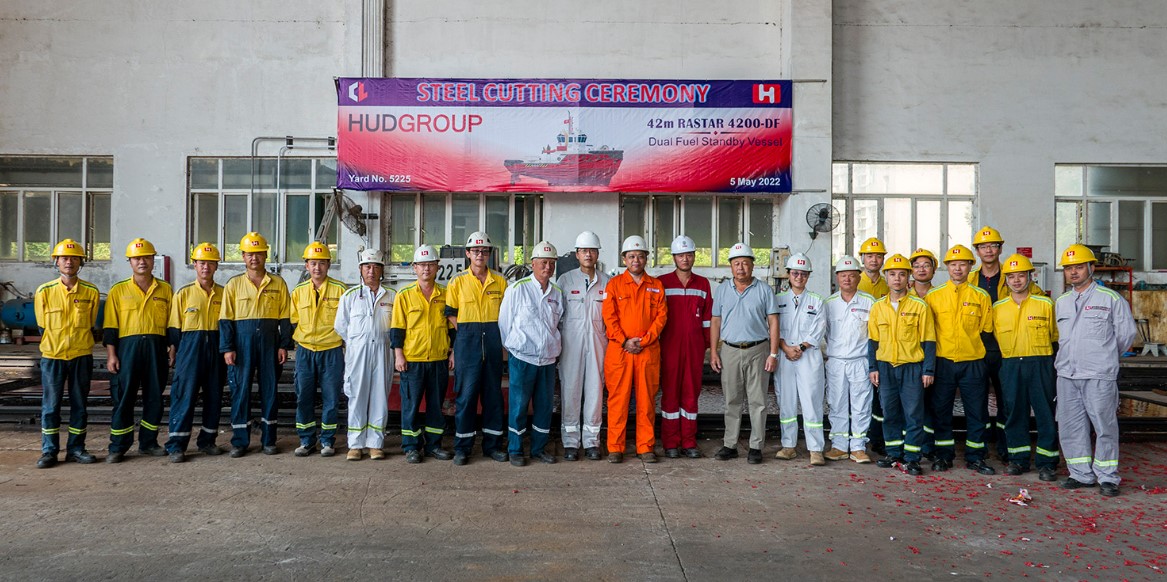
Work has started on two newbuild dual-fuel tugs which will serve Hong Kong’s first liquefied natural gas (LNG) import project.
Hongkong United Dockyards (HUD), the owner of the tugs, said in a statement that Cheoy Lee Shipyards held a steel-cutting ceremony at its Hin Lee facility in Zhuhai for the first out of two tugs.
Following completion, both of the 42 meters long tugs would go on a long-term charter to Hong Kong LNG Terminal, a joint venture consisting of HK Electric and Castle Peak Power (Capco), it said.
The vessels will support the future operations of the offshore LNG terminal in Hong Kong which will feature the world’s largest floating storage and regasification unit (FSRU).
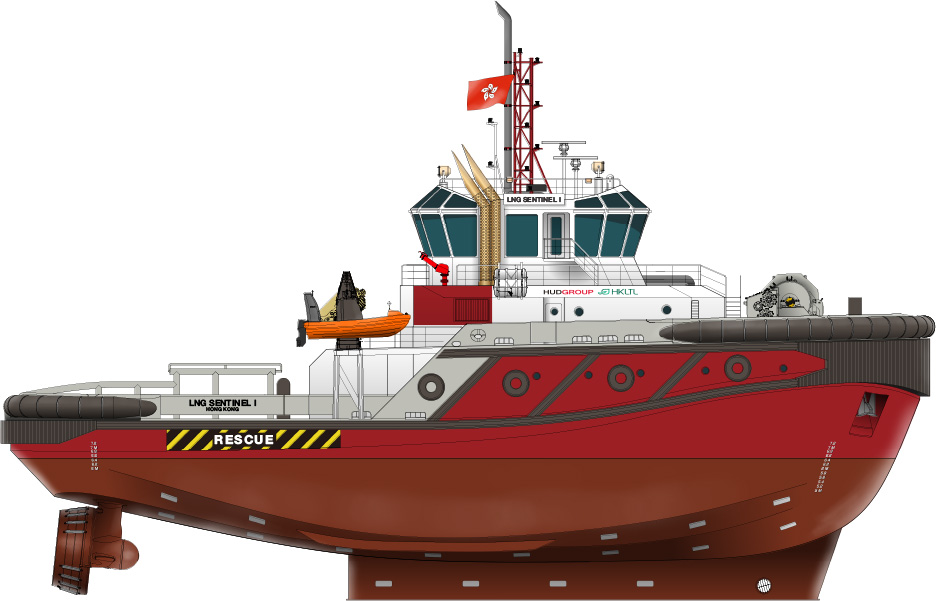
Designer Robert Allan said in separate statement the tugs would provide stand-by services, FSRU emergency towing, assistance with berthing LNG carriers, transport passengers and equipment, fire fighting, oil recovery and FSRU crew rescue services to the LNG terminal.
According to the firm, these tugs are the first dual-fuel variants of the existing RAstar 4200 vessel design which recently arrived in Mozambique to start serving Eni’s 3.4 mtpa Coral Sul FLNG.
They are designed to maximize operations on LNG and to be able to bunker LNG directly from the jetty, Robert Allan said.
LNG import terminal to start ops later this year
HK Electric said in March that the FSRU-based project had passed “key stages” of its development process and that the commissioning would start later this year.
Last year, Japan’s MOL and Dutch Vopak signed a deal to jointly own the giant FSRU which will serve the new LNG terminal in Hong Kong.
Under the deal, Vopak bought 49.99 percent of the shares from MOL in the vessel owning company of the 2017-built, 345 meters long FSRU with a regasification capacity of 800 mmscfd.
The duo will rename the vessel to Bauhinia Spirit.
According to its AIS data provided by VesselValue, the FSRU was on Monday located at Singapore LNG’s import terminal on Jurong Island. It arrived in Singapore last month.
Besides the FSRU, the Hong Kong LNG terminal project features a double berth jetty. MOL and Vopak also joined forces for the development of the project’s jetty and maintenance services.
The project forms part of Hong Kong’s initiative to reduce emissions. The city and special administrative region of China aims to replace about half of its power generation fuel with natural gas.
Regasified LNG coming from the FSRU will supply two power plants via subsea pipelines.
These include the Black Point power station located in the New Territories and Lamma power station located at Lamma Island.
Also, Shell will supply LNG as part of a long-term deal signed with HK Electric and Capco in 2019.