This story requires a subscription
This includes a single user license.
The $4 billion Cedar LNG project remains on time and on budget, with an expected in-service date in late 2028, Pembina’s management said in a business update on Tuesday.
The Haisla Nation has a 50.1 percent stake while Pembina owns 49.9 percent in the project which includes the construction of a floating LNG facility with a nameplate capacity of 3.3 mtpa, located in the traditional territory of the Haisla Nation.
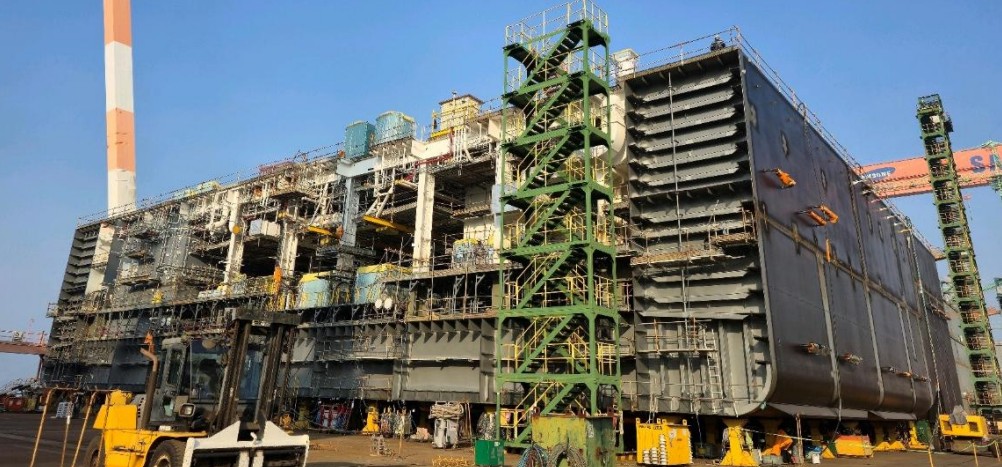
In June last year, South Korea’s Samsung Heavy Industries officially started building Cedar’s FLNG, which will be named “megúgu”.
Cedar LNG issued a notice to proceed to Samsung Heavy and Black & Veatch for its FLNG following the finalization of long-term commercial offtake agreements.
Samsung Heavy is responsible for the hull of the FLNG and topside plant processes, while Black & Veatch will provide its PRICO technology.
Pembina’s chief operating officer, Jaret Sprott, said 2026 is the “highest spend year for the project as we plan to reach several key milestones with our EPC and onshore teams.”
“Additionally, inception to date, the project is approximately 50 percent spent and approximately 80 percent committed while still on time and on budget,” he said.
He said the FLNG in South Korea will move from the dry dock to the wet dock in the middle of this year.
It will set sail from South Korea and arrive in Kitimat in the first half of 2028.

Sprott also noted that the actual onshore footprint of the project is “quite small” given the floating nature of the project.
The marine terminal facilities are currently under construction, and the mechanical completion of the marine terminal is expected at the end of 2027.

$220 million per year in fixed fees
Sprott said that approximately 70 percent of the project is structured under a fixed-price EPC arrangement, which “significantly limits cost overrun risk.”
“This is exactly how we want large projects structured and managed,” Sprott said.
“Economically, the structure is equally disciplined, a fee-for-service model that secures base cash flow with the ability to participate in upside. Pembina will generate $220 million per year in fixed fees from Cedar’s customers,” he said.
“In addition, we’ll have the opportunity to generate incremental asymmetrical upside through additional volumes and commodity upside participation. This is a result of recent contracting through which Pembina has the opportunity to increase its return under certain commodity price scenarios,” Sprott said.
Three producers
Sprott noted the project is backed by three leading producers, ARC Resources, Ovintiv, and Petronas.
“All three are valuable customers to Pembina today, and this project allows us to provide them services beginning from gas processing all the way through to end markets,” he said.
In December last year, Pembina and US oil and gas producer Ovintiv signed a 12-year agreement for 0.5 million tonnes per annum of Pembina’s liquefaction capacity at the Cedar LNG facility.
Similar in structure to the previously announced Petronas agreement for 1 mtpa, the agreement with Ovintiv is a synthetic liquefaction service structure under which Pembina will provide transportation and liquefaction capacity to Ovintiv and receive a long-term, take-or-pay revenue stream with the potential for incremental value enhancement, Pembina said.
Following the agreement with Ovintiv, Pembina now remarketed the full 1.5 mtpa of its Cedar LNG capacity to third parties.
The Canadian company previously signed a 20-year take-or-pay liquefaction tolling service agreement for 1.5 mtpa of LNG to support the final investment decision on Cedar LNG in June 2024 and ultimately maintain key project timing and economic parameters, with the expectation of remarketing the capacity at a later stage.

