
US-based engineer Black & Veatch and South Korean shipbuilder Samsung Heavy Industries have won a contract from Canada’s Cedar LNG project, a joint venture of Pembina Pipeline and the Haisla Nation.
Cedar LNG said in a statement on Tuesday it awarded the front-end engineering and design (FEED) for the project’s proposed floating liquefaction, storage and offloading unit (FLNG) to the two firms.
The FLNG project developer did not reveal any additional information regarding the contract.
Black & Veatch said in a separate statement that, along with SHI, it previously completed the pre-FEED study and now would work on the topside process plant, which includes its patented PRICO liquefaction technology.
SHI would work on the hull and LNG containment system, along with integration of topsides while also fabricating topsides modules designed by Black & Veatch, the firm said.
FEED activities are underway and will continue through this year.
Besides the contract, Cedar LNG recently submitted an application for an environmental assessment certificate to the British Columbia Environmental Assessment Office, moving the project into the 180-day application review phase.
This “key project milestone” comes following detailed studies, engineering and meaningful engagement with Indigenous and local communities, Cedar LNG said.
Cedar LNG eyes FID in 2023
Canada’s Pembina and the Haisla Nation joined forces on the proposed $2.4 billion floating LNG export facility in Kitimat, British Columbia last year.
The FLNG project would have a capacity of about 3 mtpa and would source natural gas from the prolific Montney resource play in northeast British Columbia.
Cedar LNG has secured a long-term transportation agreement on the Coastal GasLink pipeline for 400 million cubic feet per day of firm capacity.
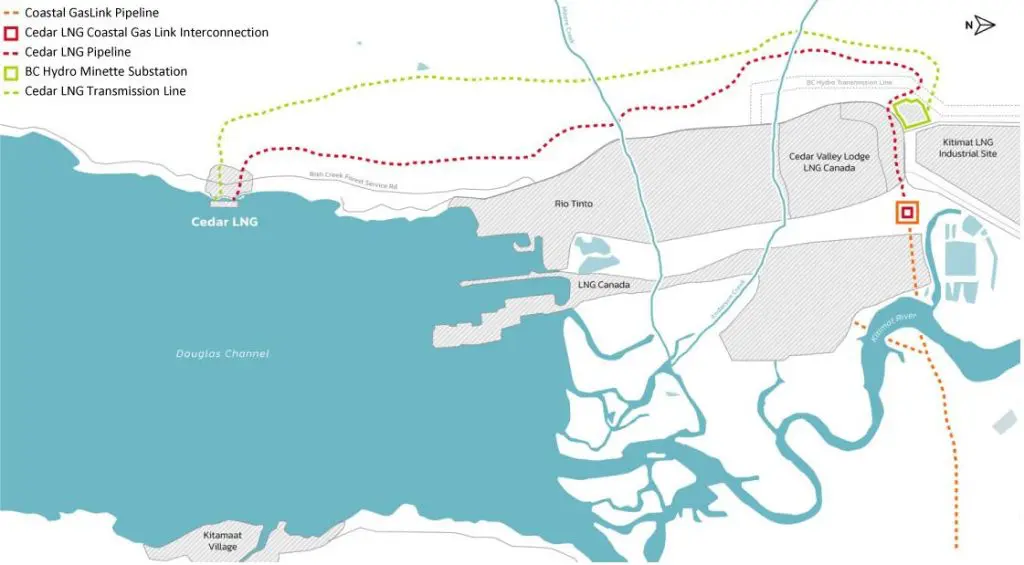
Natural gas would arrive to the site through an approximately eight-kilometer-long pipeline that would connect to the Coastal GasLink pipeline which will feed the Shell-led LNG Canada project.
Cedar LNG said it expects to make a final investment decision in 2023 following completion of the environmental assessment process.
“Subject to additional factors, including regulatory and other approvals, the expected in-service date for the project is in 2027,” it said.