This story requires a subscription
This includes a single user license.
KN announced on Wednesday that it has completed the long-term allocation procedure for the FSRU-based terminal’s regasification capacities for the period of 2033–2044.
During the procedure, the majority of the offered capacities were allocated – more than 20 terawatt-hours (TWh): 8 TWh until 2044 inclusive and a further 12 TWh until 2040, according to KN.
Long-term Klaipėda LNG terminal capacities were booked by three existing customers Ignitis, Latvenergo, and Equinor, and new terminal customers Gasum and Naftogaz.
KN launched the capacity allocation procedure in March this year, offering the market the opportunity to book up to 28 TWh of regasification capacity per year for the period of 2033–2044.
The offered capacities were divided into seven equal packages of 4 TWh per year, giving firms the option to choose periods of eight or 12 consecutive years.
Approximately 1 TWh corresponds to one conventional-sized LNG cargo.
Taking into account the results of this procedure, as well as the 4 TWh package of long-term capacities until 2044 allocated back in 2023, the total utilization of the LNG terminal will reach around 75 percent of the terminal’s nominal capacity, KN said.
According to KN, it is planned that the LNG terminal capacities that remained unallocated during this procedure may be offered to the market through repeated long-term capacity booking procedures and annual capacity allocation procedures for each year separately.
Customers that have already booked long-term capacities would be given priority in selecting cargo arrival windows and regasification periods, the firm added.
Fully booked until 2032
The terminal’s capacity is fully booked up to 2032.
In addition, part of the capacity for the period 2033–2044 had already been previously contracted.
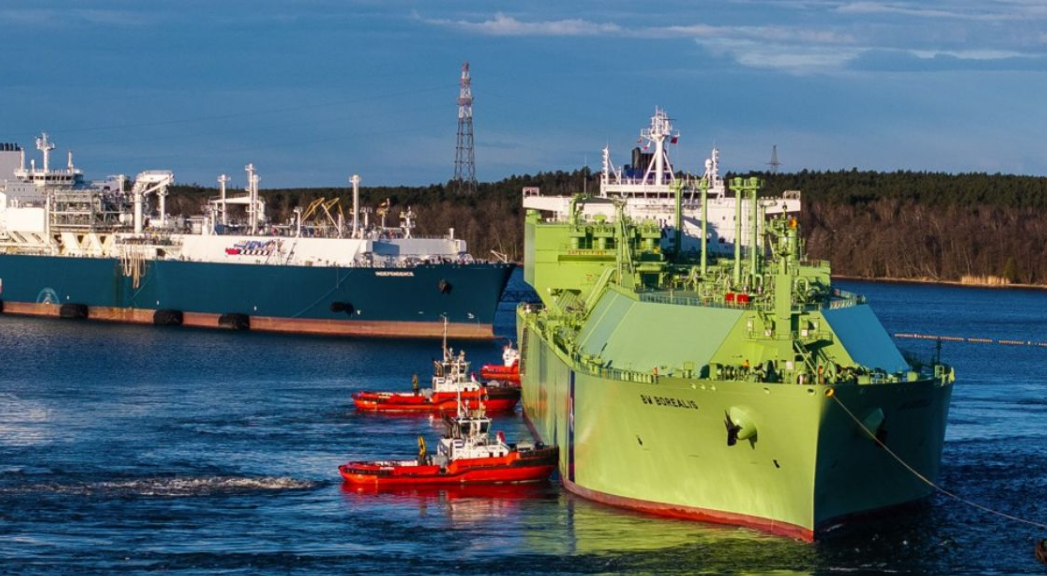
The Klaipeda FSRU-based LNG terminal currently provides regasification and reloading services, as well as biomethane liquefaction by equivalence.
In December 2024, KN Energies assumed ownership of the 170,000-cbm FSRU Independence from Hoegh Evi, and the unit was registered under the Lithuanian flag.
In March last year, the FSRU completed its 500th ship-to-ship LNG transfer in Klaipeda since the start of operations in 2014.
The majority of LNG volumes originate from Norway and the United States, but the Klaipeda FSRU-based facility has also received LNG from Nigeria, Trinidad and Tobago, Egypt, Algeria, and other countries.