
Global demand for liquefied natural gas (LNG) is estimated to rise by more than 50 percent by 2040, as industrial coal-to-gas switching gathers pace in China and South Asian and South-east Asian countries use more LNG to support their economic growth, according to Shell’s LNG Outlook 2024.
Shell said that global trade in LNG reached 404 million tonnes in 2023, up from 397 million tonnes in 2022, with tight supplies of LNG constraining growth while maintaining prices and price volatility above historic averages.
The LNG giant said that demand for natural gas has already peaked in some regions but continues to rise globally, with LNG demand expected to reach around 625-685 million tonnes a year in 2040, according to the latest industry estimates.
Shell said last year that it expected LNG demand to reach 650 to over 700 million tonnes a year by 2040.
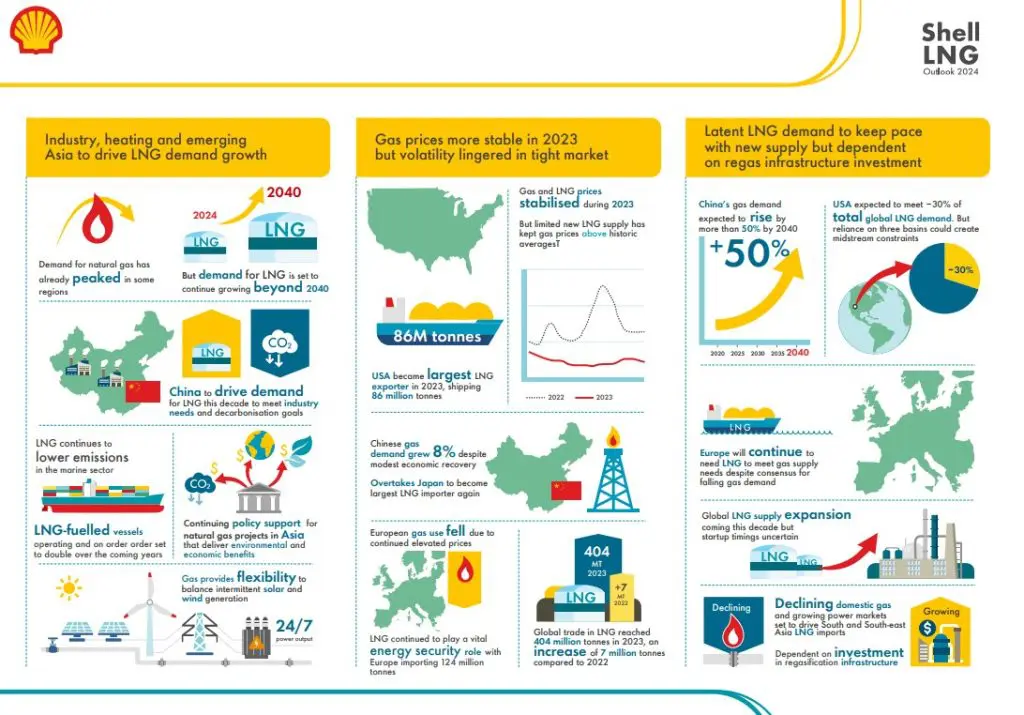
“China is likely to dominate LNG demand growth this decade as its industry seeks to cut carbon emissions by switching from coal to gas,” said Steve Hill, executive vice president for Shell Energy.
“With China’s coal-based steel sector accounting for more emissions than the total emissions of the UK, Germany and Turkey combined, gas has an essential role to play in tackling one of the world’s biggest sources of carbon emissions and local air pollution,” he said.
Over the following decade, declining domestic gas production in parts of South Asia and South-east Asia could drive a surge in demand for LNG as these economies increasingly need fuel for gas-fired power plants or industry. However, countries in South Asia and South-east Asia would need significant investments in gas import infrastructure, Shell said.
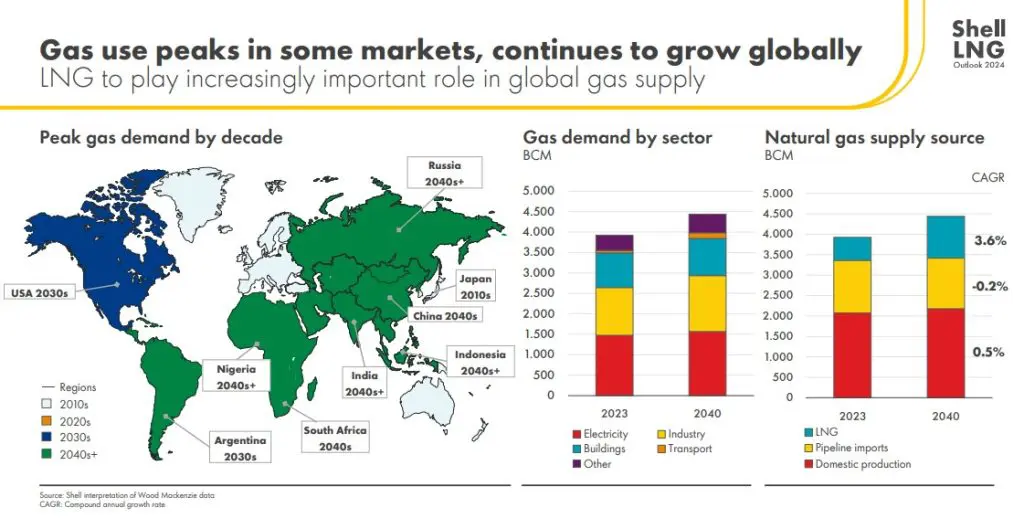
The Shell LNG Outlook 2024 shows that gas complements wind and solar power in countries with high levels of renewables in their power generation mix, providing short-term flexibility and long-term security of supply, it said.
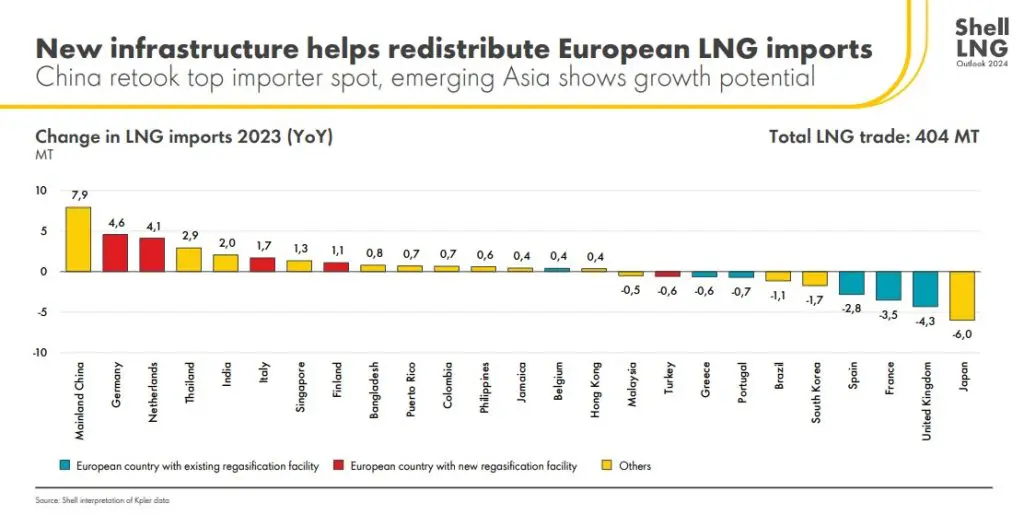
European LNG imports remained at similar levels to 2022
Shell said that LNG continued to play a “vital role” in European energy security in 2023, following a slump in Russian pipeline exports to Europe in 2022, with new regasification facilities helping to improve security of energy supplies.
European LNG imports remained at similar levels to 2022, despite an overall decline in European gas demand in 2023, Shell said.
Relatively mild winter temperatures in countries that rely on gas for heating, combined with high gas storage levels, stronger nuclear power generation and a modest economic recovery in China, all helped balance the global gas market in 2023, the firm said.
Shell said this helped bring down and stabilize gas prices in the key importing regions of Europe and East Asia compared to the record highs and “unprecedented volatility” seen from late 2021 through 2022. However, gas prices and volatility remained significantly higher in 2023 than in the 2017-2020 period, it said.
“Despite a well-supplied global market in 2023, the lack of Russian pipeline gas supply to Europe and a limited amount of LNG supply growth over the last year mean that the global gas market remains structurally tight,” Shell said.