This story requires a subscription
This includes a single user license.
Naftogaz announced on Monday that these LNG supplies will be sourced from the US and supplied to Germany by TotalEnergies.
Following regasification by Deutsche ReGas, the gas will be delivered via pipelines through Poland to Ukraine, where it will be available for Naftogaz to meet the country’s needs in February.
Naftogaz did not provide further details regarding the LNG supplies.
Ingo Wagner, CEO of Deutsche ReGas, said the “first-ever delivery of regasified LNG from Germany to Ukraine was made possible only through the professional and trusting collaboration of all partners.”
“This underscores the strategic importance of our location, not only for the market area, but especially for our Central and Eastern European neighbors,” he said.
Sergii Koretskyi, CEO of Naftogaz, said, “This winter is the most difficult since the start of the war, due to constant shelling of gas infrastructure and extreme cold weather.”
“The Naftogaz team has been working systematically with our international partners to diversify sources and routes in order to ensure stable supplies for Ukrainians. This new partnership opens up a new reliable import route for Ukraine for the current year, and this agreement is only the first step toward a long-term partnership,” Koretskyi said.
Poland’s Orlen recently delivered one US LNG cargo to Ukraine’s Naftogaz via the Swinoujscie terminal in Poland.
In November 2025, Orlen agreed to supply three more LNG cargoes, equivalent to over 300 billion cubic feet (bcf) of gas, to Naftogaz from the US in the first quarter of 2026.
In addition to Orlen’s supplies, a joint venture of Greek companies Aktor and DEPA recently signed its first deal to supply a US LNG cargo to Naftogaz via DESFA’s Revithoussa LNG terminal in Greece.
Mukran FSRU
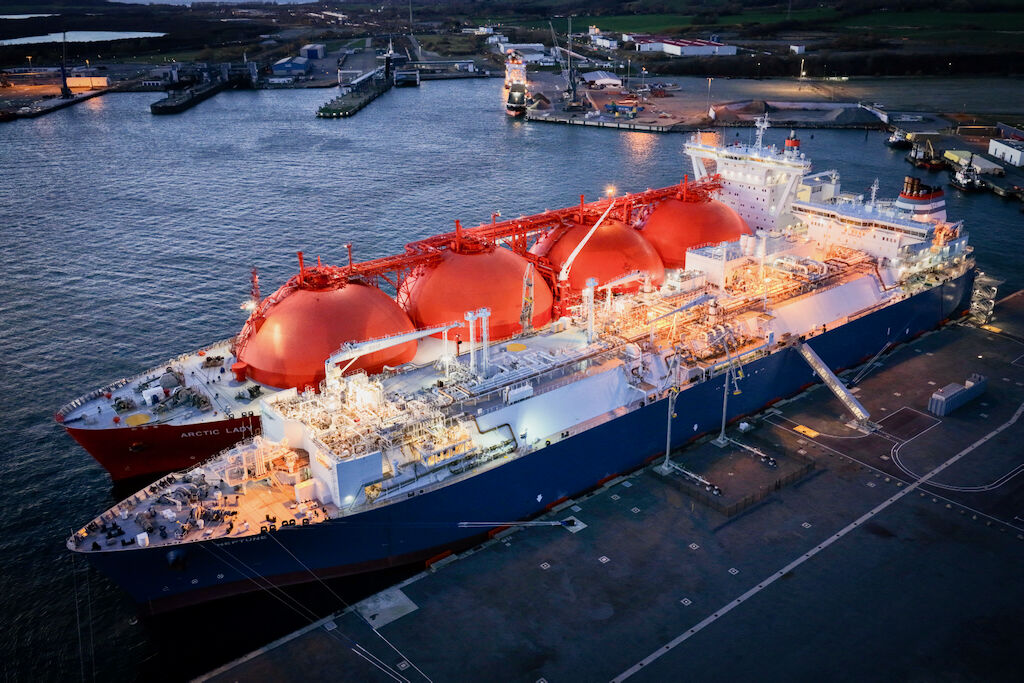
Last week, the LNG carrier Minerva Amorgos delivered a Plaquemines LNG cargo to the FSRU-based LNG import facility in Mukran, Germany’s only operational private LNG import terminal, after two icebreakers cleared the path for the vessel.
Before this, the 174,000-cbm LNG carrier had been waiting off Mukran for days to unload its US LNG cargo due to icy conditions and the malfunction of the federally-owned icebreaker Neuwerk in the Greifswalder Bodden.
Moreover, Deutsche ReGas recently said that its FSRU-based LNG import facility in Mukran regasified 12.9 TWh over the past three months.
The company claims this is the largest gas volume among all floating LNG terminals in Europe during the period.
Moreover, the company is offering up to two billion cubic meters per annum of additional long-term regasification capacity at its FSRU-based LNG terminal.
The LNG terminal operator is advancing its plans to expand its facility on the Baltic Sea to the nameplate capacity of 13.5 bcma under the BNetzA regulatory exemption.
In December, a spokesman for Deutsche ReGas told LNG Prime that the company was running a tender process to bring back a second floating storage and regasification unit at its LNG import facility in Mukran.
The Mukran LNG terminal currently consists of FSRU Neptune, after Deutsche ReGas terminated the charter contract for the 174,000-cbm FSRU Energos Power with the German government.
The FSRU Neptune is 50 percent owned by Hoegh Evi and sub-chartered by Deutsche ReGas from TotalEnergies, who also holds capacity rights at the Mukran facility along with trader MET.