
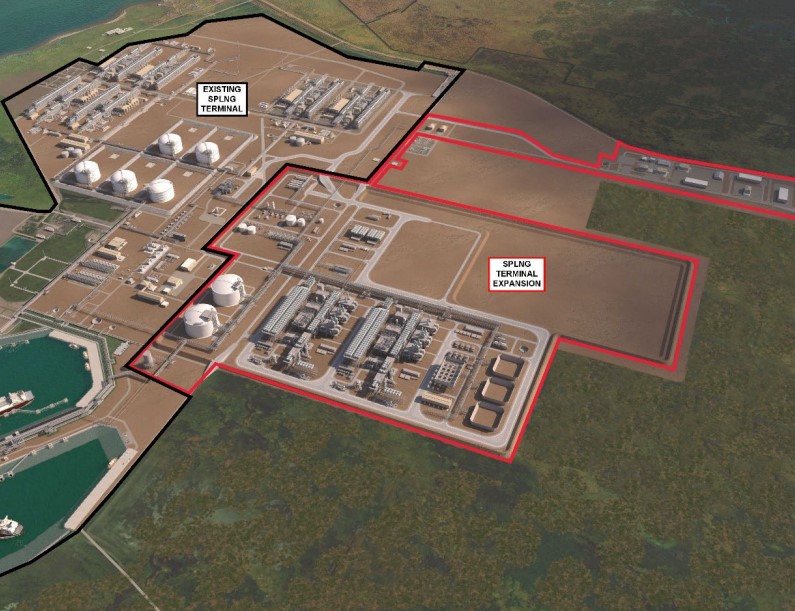
US LNG exporting giant Cheniere now plans to build two instead of three liquefaction trains as part of the Sabine Pass expansion project in Louisiana. Cheniere said the company is not reducing its growth ambition at Sabine Pass, and with this move it would achieve similar production with an optimized unit/cost footprint.
Sabine Pass currently has a capacity of about 30 mtpa following the launch of the sixth train in February last year, while Cheniere’s three-train Corpus Christi plant in Texas can produce about 15 mtpa of LNG and is undergoing expansion.
Earlier this year, Cheniere initiated the pre-filing review process with the US FERC for the Sabine Pass Stage 5 expansion project.
The original plans included the construction of three large-scale liquefaction trains, each with a production capacity of about 6.5 mtpa of LNG, a boil-off-gas (BOG) reliquefaction unit with a production capacity of 0.75 mtpa of LNG, and also two 220,000-cbm LNG storage tanks.
However, Cheniere now aims to construct two LNG trains with a nameplate capacity of about 7 mtpa each using ConocoPhillips liquefaction technology, according to a draft resource report filed with the FERC in November.
The Houston-based firm did not say in the report why it decided to build two trains as part of the project.
LNG Prime invited Cheniere to comment on the matter.
“The short answer is that we are best-sizing the trains and configuration of our proposed SPL expansion project to, together with estimated debottlenecking and growth opportunities, achieve similar production with an optimized unit/cost footprint,” a Cheniere spokesman said later on Wednesday.
“We are focused on long-term and durable value creation. As such, we are continuously optimizing the configuration of this brownfield expansion to maximize its economics, scale, and speed to market,” he said.
“In short, we are not reducing our overall growth ambition at Sabine Pass. We continue to progress the commercialization of the expansion – an up to approximately 20 mtpa increase in capacity at our Sabine Pass facility, inclusive of estimated debottlenecking opportunities – and we look forward to advancing on our financial, regulatory and construction milestones to have it producing LNG by the end of this decade,” the spokesman said.
49.84 mtpa
The proposed Sabine Pass expansion facilities will be interconnected and operated with the existing terminal, while Cheniere is also proposing an increase in the authorized maximum loading rate of LNG carriers and simultaneous loading capabilities for the three existing jetties.
Sabine Pass is proposing to increase loading to about 14,000 cbm per hour of LNG from the two new storage tanks to the existing marine berths.
To deliver about 2.5 billion cubic feet per day (Bcf/d) of natural gas to the expansion project, Cheniere’s unit Sabine Crossing proposes to build a new, 48-inch diameter natural gas pipeline of about 5.3 miles in length extending from Jefferson County, Texas, and into the LNG terminal in Cameron Parish, Louisiana.
The Sabine Pass LNG terminal currently has approval to produce and export 1661.94 Bcf/y of LNG (33.01 mtpa).
Cheniere said in the report the expansion project would produce an additional 843.15 Bcf/y of LNG, equivalent to about of 16.83 mtpa of LNG for export or 2,050 MMscfd.
Also, the marine berths would be able to accommodate the total project exports of 49.84 mtpa, it said.
Launch in 2031
Cheniere said that engineering for the expansion project has progressed from preliminary design and is currently in the front-end engineering and design stage.
Cheniere engaged Bechtel to complete FEED.
The firm expects detailed engineering to start in the third quarter of 2025.
According to Cheniere, the LNG exporter aims to start construction in February 2026 and to complete it in October 2030.
Cheniere plans to complete the commissioning and launch the new project in June 2031.
(Article updated to include comments by a Cheniere spokesman.)