This story requires a subscription
This includes a single user license.
Golar revealed this in its first-quarter report on Wednesday.
The company said its FLNG offering is “becoming increasingly compelling in a more energy-constrained and geopolitically uncertain world.”
Golar noted that offtakers and resource owners are keen to diversify sources of supply following events in the Middle East.
The company said that this has created a “new sense of urgency” to existing commercial discussions and introduced new opportunities.
“Recent progress across multiple projects potentially suited to a similarly specced FLNG provides sufficient support for committing capital to a fourth FLNG. Accordingly, key long-lead items were reserved in May 2026,” the company said.
The company said it is targeting to order its fourth FLNG conversion in 2026.
Golar said in the first-quarter presentation that it is in “active deployment discussions in Africa, the Middle East, and South America, targeting competitive gas resources with strong counterparties.”
The firm also said that potential donor LNG carriers were shortlisted, while inspections are ongoing to identify the “strongest conversion candidates.”
In November 2025, Golar said that it remains on track to decide on the vessel design for its fourth FLNG conversion in “the coming months.”
The company said at the time that it planned to order long-lead equipment in the fourth quarter of 2025.
However, Golar LNG said in its fourth-quarter report in February this year that it would slow down plans for its fourth and fifth FLNG, while it also initiated a formal process to evaluate strategic alternatives for the company.
Golar also obtained updated yard availability, price, and delivery terms during the fourth quarter for each of its three different FLNG designs, ranging in size from 2 to 5 mtpa.
FLNG projects
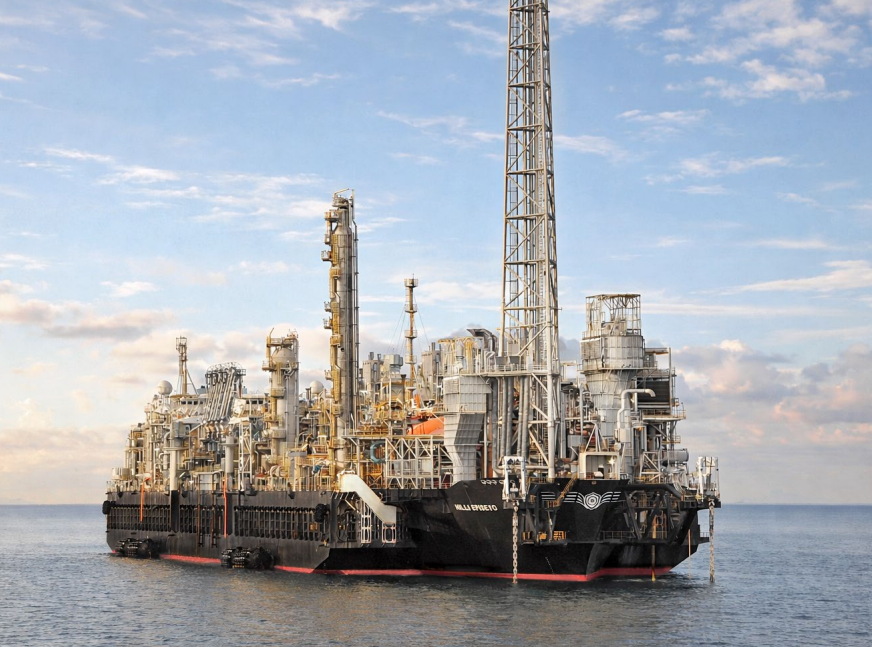
In aggregate, across FLNG Hilli and FLNG Gimi, Golar has 5.1 mtpa of liquefaction capacity on the water, a further 3.5 mtpa currently under conversion in China, and long-lead items for the fourth unit reserved.
Last year, the company secured $14 billion in adjusted Ebitda backlog between the two 20-year contracts for the FLNG Hilli and MKII FLNG to SESA in Argentina.
The company said in the first-quarter report that it entered into a 10 percent investment in San Matías Pipeline, developing the dedicated gas pipeline for the Hilli and MKII FLNG projects in Argentina.
Moreover, Golar said that Hilli maintained “leading operational track record” offshore Cameroon, offloading her 150th cargo in April and 152nd cargo this week.
The existing contract in Cameroon ends in the third quarter of 2026, and the unit will be towed to Seatrium’s shipyard in Singapore, where upgrades and life extension work will be carried out prior to its deployment in Argentina.
FLNG Gimi, which serves the BP-operated GTA project offshore Mauritania and Senegal, has offloaded 33 cargoes, and production “remains ahead of schedule”, according to Golar.
The FLNG “continues to reliably produce at volumes that on an annualized basis would significantly surpass its contractual committed volumes of 2.4 mtpa,” the company said.
“Solid” operational performance
Golar reported first-quarter 2026 net income of $84 million, inclusive of $37 million of non-cash items.
The company reported adjusted Ebidta of $106 million and total cash of $1 billion.
Golar CEO Karl Frederik Staubo said the first-quarter saw “solid operational performance with continued 100 percent economic uptime for FLNG Hilli and strong operational performance from FLNG Gimi producing 19 percent more than the contractual committed volume.”
According to the CEO, the MKII FLNG under conversion progressed according to budget and schedule during the quarter.
“Geopolitical events continuing in Ukraine and Russia combined with significant escalation in the Middle East has again driven commodity prices higher and put pressure on the global energy markets,” Staubo said.
“We see strengthening demand for energy security and diversification. This reflects on Golar’s business by driving strong momentum in commercial discussions for incremental FLNG projects as well as increased earnings for our commodity exposure. We are ramping up activities to order our fourth FLNG within 2026 and to secure attractive long-term FLNG projects,” he said.
Faster delivery
Staubo provided further details regarding commercial discussions and the fourth FLNG during the earnings call later on Wednesday.
He discussed the effects of the disruptions in the Middle East and the bombing of the giant Ras Laffan LNG plant in Qatar, which has taken out two trains for three to five years, on commercial discussions.
Staubo said that obviously “impacts the forward supply demand dynamics, and also the price expectations that people can foresee in the front months of an FLNG charter.”
“That has caused the drive for urgency and to try to get a delivery as early as possible. This is why we feel strongly about securing long-lead items to ensure that we can deliver an FLNG in 36 months, which, the way we see it will be the earliest available liquefaction capacity globally,” he said.
“When you then have several parties interested to secure that capacity at much higher offtake prices than they originally subscribed to, you can translate that into the commercial discussions. So instead of having sort of a price war with the counterpart, it’s who gets the first delivery. And that’s a much better dynamic for us than to discuss tariff details,” Staubo said.
He also discussed the donor vessel, which will be used for Golar’s first two FLNG designs, MKI and MKII as MKIII includes a newbuild.
He said the donor vessel “is not what dictates MKI or II. The magnitude of long-leads will impact MKI or II.”
“And for now, we are ensuring that at least we can do an MKII. So that’s where we’ll probably see the next one coming,” Staubo said.