
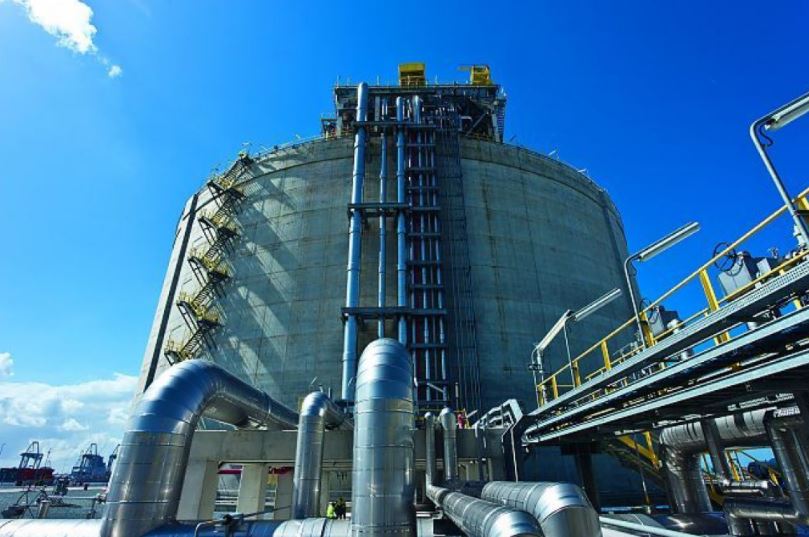
Dutch gas grid operator Gasunie is joining forces with the German government and RWE to build the Brunsbuettel LNG import terminal as the country looks to reduce reliance on Russian gas.
In that regard, Gasunie, state-owned Kreditanstalt fur Wiederaufbau (KfW), and German energy firm RWE signed a memorandum of understanding on Friday.
Gasunie, a shareholder in the Dutch Gate facility, said in a statement it would operate the LNG terminal and it plans to start building the plant with an annual capacity of 8 billion cbm this year.
In addition to LNG, the terminal would also be made suitable for importing (green) hydrogen, it said.
Germany’s Ministry for Economic Affairs and Climate said in a separate statement it would take a 50 percent share in the LNG terminal through a financial contribution on behalf of the German government.
Gasunie will have a 40 percent operating stake while RWE will hold 10 percent.
Construction could take up to 3.5 years
The ministry did not reveal any financial details of the deal but it said that the construction of the onshore terminal could take about 3-3.5 years.
However, in the case of an FSRU-based facility, it would take about two years to launch it, the ministry said.
This deal comes just a week after Chancellor Olaf Scholz said Germany had decided to back the construction of two LNG import terminals as part of efforts to reduce dependence on Russian pipeline gas imports.
The facilities include the Brunsbuettel LNG terminal and Uniper’s LNG import and hydrogen facility in Wilhelmshaven.
Uniper previously planned to build the Wilhelmshaven FSRU terminal. The unit of Finland’s Fortum switched plans from LNG to hydrogen last year but the company is now considering to revive the project.
Besides these two projects, Germany’s Hanseatic Energy Hub is also working on the Stade LNG import terminal near Hamburg while Belgium-based Tree Energy Solutions (TES) is looking to import both LNG and hydrogen via a planned hub in the German port of Wilhelmshaven.
Expanding import options
Germany is a major gas importer and gets about 55 percent of these supplies from Russia, followed by Norway with about 30 percent, and the Netherlands with about 13 percent, according to the ministry.
The country currently has no large LNG import terminals.
German Economy Minister Robert Habeck said, “it is absolutely clear that we have to make the energy supply climate-neutral, consistently reduce gas consumption and push ahead with the expansion of renewables and the production of hydrogen at full speed.”
However, he said Germany needs gas for the transition.
“At the same time, it is necessary to reduce dependence on Russian imports as soon as possible. With an LNG terminal in Brunsbuettel, we are expanding the import options,” Habeck said.
Changes at German LNG Terminal
German LNG Terminal, the JV behind the Brunsbuettel LNG project, has been working on the facility since 2018.
The JV consists of Gasunie and Germany’s Oiltanking while Dutch tank firm Vopak decided to become a passive shareholder last year.
RWE previously expressed interest to take a large part of the terminal’s capacity as well as to import hydrogen from Australia to Brunsbuettel.
Following the new deal with the government, Vopak and Oiltanking would leave the group of shareholders ultimately by May 2022, German LNG Terminal said in a statement on Saturday.
“The current shareholders have agreed that Gasunie is the best partner for the German government to complete the terminal project quickly and successfully in order to ensure stable energy supply with gas and enhance security of supply in Germany,” it said.
Also, the former joint managing director Philipp Kroepels will return to Oiltanking while Michael Kleemiß will remain managing director of the JV.
Contractor to start preparatory work
German LNG Terminal submitted its application for planning approval to the Transport Planning Authority in Kiel in Summer 2021.
It would now move ahead at “full speed” with the process, the JV said.
In addition, the EPC contractor consisting of Cobra and Sener would be commissioned to start the preparatory work immediately, German LNG Terminal said.
The project includes a jetty with two berths, with both unloading and loading capabilities, for LNG carriers ranging from 1,000 cbm up to 265,000 cbm.
It will also have two LNG tanks each with a capacity of 165,000 cbm.