
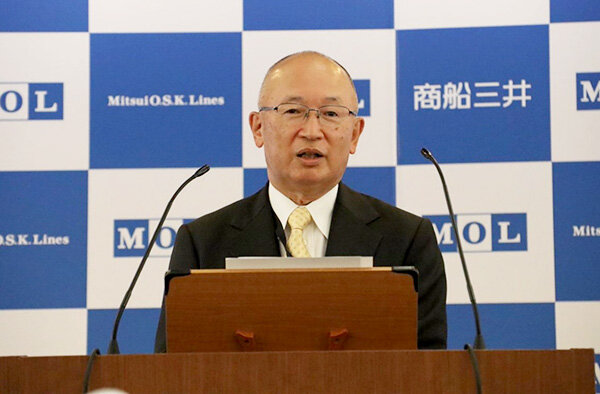
Japan’s MOL will continue to ship liquefied natural gas from Russian LNG export plants, according to the company’s CEO Takeshi Hashimoto.
The EU and the US have imposed sanctions on Russia and Russian companies due to the war in Ukraine while a large number of firms decided to withdraw from their operations in the country.
Japan is the biggest buyer of LNG from the Gazprom-operated Sakhalin-2 LNG export terminal while tankers owned by Japanese firms such as MOL transport these volumes.
MOL also transports volumes from the Yamal LNG export plant operated by Russia’s Novatek.
“Some companies decided to withdraw from Russia-related business, but our group will continue to offer stable transport services, placing the highest priority on securing the safety of crewmembers, cargo, and vessels, as a company that develops a social infrastructure business centered on ocean shipping, transporting commodities essential to people’s lives,” Hashimoto said in his New Year’s message to MOL officers and employees on January 4.
“Considering about strategic importance of energy supply under current circumstances, we will continue our energy transport business, mainly LNG, from Russia, as long as we can, and this is also in line with the direction of the Japanese government’s policy,” he said.
“Of course, at the same time I pray that the situation will be brought to an end as soon as possible and that the people of Ukraine will return to safety and peace,” Hashimoto said.
Sakhalin LNG
Back in October last year, MOL signed a charter deal with the new operator of the Sakhalin-2 LNG export terminal in Russia for the 2008-built LNG carrier Grand Mereya.
MOL signed the deal via a unit owned 60 percent by the company with Sakhalin Energy LLC.
The 147,000-cbm vessel has been transporting LNG from the Sakhalin project under a long-term charter contract with Sakhalin Energy Investment Company Limited, the former operator of the project.
Most of the volumes produced at the Sakhalin LNG plant land in Japan, followed by South Korea, Taiwan, and China.
President Vladimir Putin signed a decree in June allowing Russia to take charge of the Sakhalin-2 project due to Western sanctions imposed on Russia.
Sakhalin Energy LLC, the new operator of the Sakhalin-2 project, launched its operations on August 19.
Shell had a 27.5 percent interest in in the original entity, while Russia’s Gazprom had a 50 percent operating stake. Japan’s Mitsui had 12.5 percent stake and compatriot Mitsubishi had 10 percent in the plant.
Gazprom remains the operator of the new entity, while Japan’s Mitsui and Mitsubishi won approvals from the Russian government to take stakes in the new operator.
Shell said it would not take equity in the new terminal operator.
Novatek’s projects
Besides the Sakhalin plant, MOL is also part of Novatek’s Yamal LNG export plant as well as other projects being developed by the latter.
MOL has operated ice-breaking LNG carriers on the NSR for Novatek’s Yamal LNG project since March 2018.
In addition, the company will operate ice-breaking LNG carriers for the Arctic LNG 2 project as well.
The first GBS of this project is expected to go into service by the end of 2023.
MOL expects record high profits
According to MOL’s website, the company’s fleet included 698 vessels as of March 2022, a total of 50.8 million deadweight tons.
Besides a large fleet of LNG carriers, MOL operates containerships, bulkers, car carriers, tankers, etc.
“We expect to achieve record high profits for the current fiscal year, benefiting from strong demand for ocean going shipping and the accompanying surge in market rates, as we did in the previous fiscal year,” Hashimoto pointed out during the speech.
“On the other hand, freight rates have already begun to decline in some segments, especially container segment, as logistics disruption is coming to an end with the normalization of society,” he said.
“The shipping market is always volatile, and we expect a reversal in market conditions,” he said.