This story requires a subscription
This includes a single user license.
FortisBC announced the milestone LNG bunkering in a statement on Thursday, but it did not provide further information regarding the operation.
Since initiating LNG bunkering operations in 2016, FortisBC has steadily expanded its capabilities and partnerships, including an agreement with the Musqueam Indian Band to collaborate on LNG projects, “helping vessel operators transition away from higher‑emitting fuels in alignment with the provincial government’s Look West strategy,” the company said.
As more operators convert vessels to LNG, FortisBC continues to focus on meeting demand and advocating for expanded LNG infrastructure to position British Columbia as a “leading” marine bunkering hub.
FortisBC said the delivery follows a year of firsts at the Port of Vancouver for LNG produced at its Tilbury facility and delivered through Seaspan Energy’s LNG bunkering vessels.
These include Canada’s first ship-to-ship LNG transfer, the first LNG transfer to a car carrier, and the first cruise ship bound for Alaska fueled with LNG.
In Vancouver’s English Bay, the first ship-to-ship LNG transfer to a container vessel was also completed, FortisBC said.
“We’re continuing to build on those milestones, with development of greater ship-to-ship fuelling capabilities and additional infrastructure to meet growing demand for LNG in transpacific shipping,” the company said.
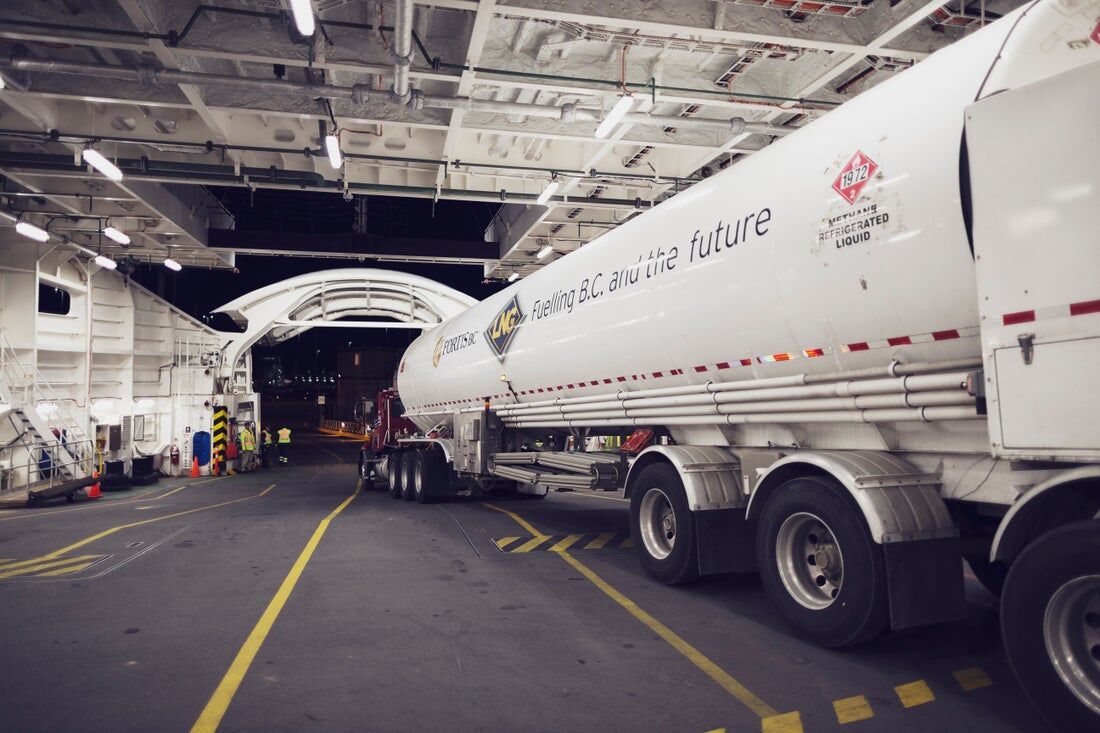
FortisBC noted that a “key” driver of this growth in LNG marine refueling has been its collaboration with Seaspan Ferries and BC Ferries to develop proprietary tanker‑truck technology that enables LNG fueling directly onboard vessels.
The Seaspan Swift ferry was the first in North America to receive LNG fuel via delivery truck on-board an open vehicle deck, the company added.