This story requires a subscription
This includes a single user license.
JGC said in a statement on Tuesday that the package is being developed using Honeywell’s LNG process technologies and is targeted for completion in fiscal year 2026.
Once deployed, it is expected to reduce the time from order to delivery by more than one year, depending on project scope and customer requirements, JGC claims.
The Japanese firm noted that FLNG facilities have traditionally been designed on a bespoke basis in coordination with technology licensors and shipowners to match each customer’s specifications.
While tailored engineering can address unique operating conditions, it can also increase engineering hours, extend schedules, and raise overall project costs, JGC said.
Developed with licensors, the package establishes “refined standard specifications to reduce post-order engineering and support repeatable, modular execution at lower cost,” it said.
The package is based on Honeywell’s dual-mix refrigerant system (AP DMR).
Honeywell provides core process technologies across the LNG value chain, including LNG liquefaction technology and Honeywell UOP gas pretreatment solutions.
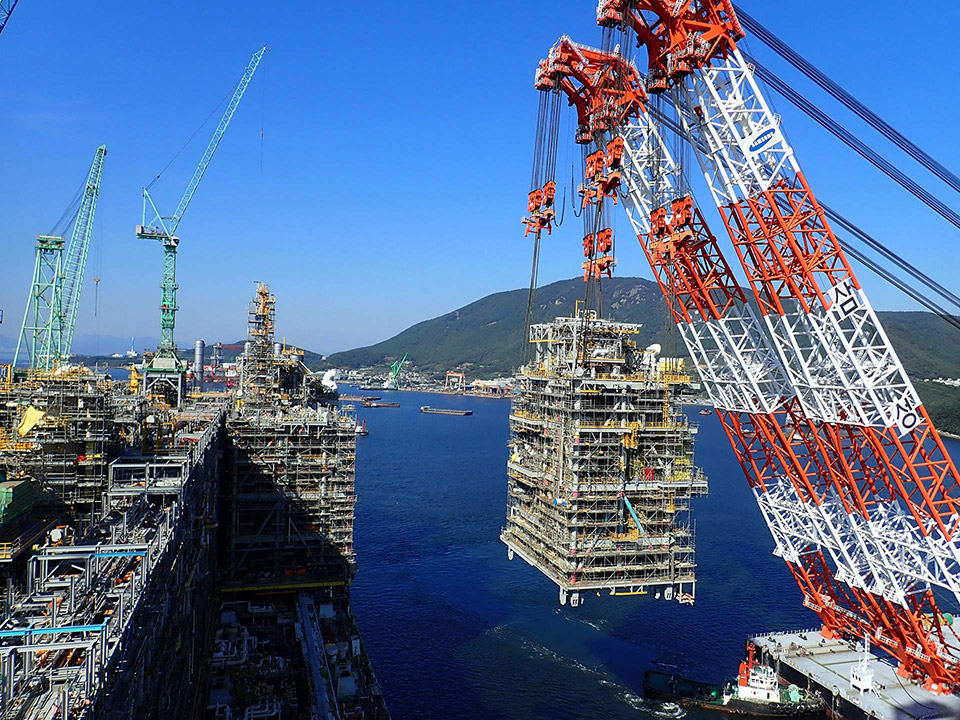
“These capabilities will be combined with JGC’s engineering expertise, including experience on one of the world’s largest FLNG projects, and its proprietary modular design approach focused on high spatial density and high throughput within limited topside area,” JGC said.
Demand up for small- to mid-scale FLNG solutions
JGC said that demand for small- to mid-scale FLNG solutions has grown as global energy needs rise and supply sources diversify.
At the same time, customers are placing greater emphasis on project speed and schedule certainty, driving interest in standardized, repeatable designs, it said.
“By leveraging the inherent flexibility of FLNG, the package is intended to expand LNG project options in locations where onshore development is constrained by geography or geopolitics, supporting faster monetization of small- to mid-sized gas fields, and earlier start-up of energy supply,” JGC said.
Building on the success of Coral Sul FLNG, Technip Energies, JGC, and Samsung Heavy Industries won a contract to progress the work on Eni’s second FLNG project in Mozambique, Coral Norte (Coral North).
Last year, Eni and its partners took a final investment decision on the second FLNG project in Mozambique worth more than $7 billion.
With a 3.6 mtpa liquefaction capacity, Coral North will double Mozambique’s total LNG output to 7 mtpa.
JGC and Samsung Heavy are also building the third floating LNG producer for Malaysian energy giant Petronas.
This third FLNG facility will produce 2.1 mtpa of LNG and is targeted to start operations in May 2027.