
This story requires a subscription
This includes a single user license.
In March this year, Delfin LNG, a unit of Delfin Midstream, secured a five-year permit extension from DOE.
This extended the start date for Delfin’s export authorization for exports of up to 1.8 billion cubic feet per day (Bcf/d) of natural gas as LNG to non-free trade agreement countries to June 1, 2029.
However, in May, Delfin submitted a request to DOE to amend its existing long-term, multi-contract authority to export LNG to FTA and non-FTA nations.
Specifically, Delfin requested that DOE amend its non-FTA export authorization to allow it to start commercial non-FTA exports of LNG by June 1, 2031.
“Good cause”
DOE said in its order dated November 25 that Delfin has “shown that it made good faith efforts to meet its prior export commencement deadline (June 1, 2029), but that it encountered regulatory delays that were not resolved until MARAD issued the DWPA License earlier this year.”
“We also note that Delfin has taken a modest, incremental approach to seeking its export commencement extensions, which further supports the reasonableness of the current extension,” it said.
“For all of these reasons, we find that Delfin has shown good cause for the additional two-year extension,” DOE said.
DOE also found that it is necessary to amend Delfin’s authorizations to provide three additional years for Delfin to export the approved FTA and non-FTA volumes of LNG with a combined total of 657.5 Bcf/yr of natural gas beyond the export term for each authorization ending on December 31, 2050.
During this “make-up period”, which will extend through December 31, 2053, Delfin will be permitted to export any approved volume of LNG that it is unable to export during the original export term, DOE said.
Design changes
Concurrently with this order, DOE issued a separate order to amend Delfin’s long-term
authorizations to reflect refinements in the design of its floating LNG project.
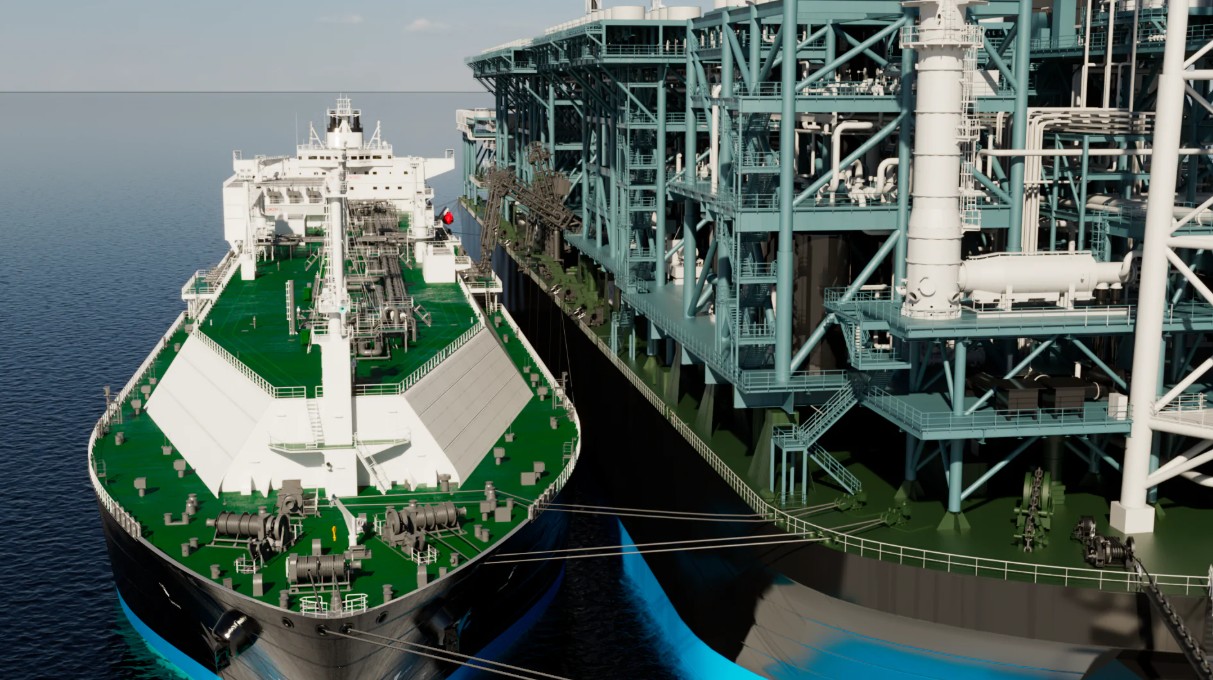
In Delfin’s non-FTA authorization issued in 2017, DOE summarized Delfin’s application in stating that the proposed project would be comprised of “four floating liquefied natural gas vessels (FLNGVs),” and that each FLNGV “would produce 3.3 million metric tons per annum (mtpa) of LNG for export, or 13.3 mtpa for the entire facility, which is equivalent to 657.5 Bcf/yr of natural gas for export.”
In its new request, Delfin states that the FLNG industry has continued to progress and evolve since Delfin obtained its export authorizations from DOE, thus allowing Delfin to adopt a variety of refinements to its project.
These include refinements in engineering that reduce air emissions (by incorporating waste heat recovery), modifications to the mooring systems to reduce construction impacts and seabed disturbances, and the implementation of “novel technologies” to optimize the physical design of Delfin’s FLNGVs, allowing Delfin to increase the LNG production capacity of each FLNGV.
13.2 mtpa
Delfin stated that, as a result of these refinements, it modified its project as presented to MARAD in its DWPA License proceeding to “include only three, rather than four, new build FLNGVs that would each process in the nominal design case of approximately 4 mtpa.
The company said that, in this optimized design scenario, “each of the three FLNGVs would
produce 4.4 mtpa of LNG for export, for a total project output for the three FLNGVs of 13.2 mtpa.”
Delfin said that it is not requesting any change in its authorized export volume, which “remains consistent with its current project design.”
Upon review of the request, DOE found that it is “necessary and appropriate” to grant the amendment to the project description.
“Delfin’s long-term authorizations, order Nos. 3393 and 4028, both as amended, are further amended to reflect the current design of Delfin’s project in accordance with the license recently granted to Delfin by MARAD under the DWPA, effective immediately,” DOE said.
FID on first FLNG
Earlier this month, Dudley Poston, CEO of Delfin, said that the company plans to make a final investment decision on the first FLNG vessel in the coming weeks.
UAE-based International Resources Holding (IRH) signed a 20-year heads of agreement with Delfin and energy trader Vitol to buy 1 million tonnes per annum from Delfin’s planned floating LNG project in the US.
Under the agreement, Delfin Midstream’s Delfin LNG will supply LNG on a free-on-board (FOB) basis to Vitol, which will act as the offtaker and deliver the volumes to IRH Global Trading (IRHGT), IRH’s global trading arm.
The three firms said that definitive agreements are expected to be concluded in the coming weeks.
In 2022, Delfin Midstream signed a long-term deal to supply 0.5 million tonnes per annum of LNG on a free on-board (FOB) basis for a 15-year period to a unit of energy trader Vitol.
In addition to the SPA, Vitol completed a strategic investment in the company.
Samsung to build FLNG
In October, Delfin Midstream entered into a letter of award with South Korea’s Samsung Heavy Industries for its first FLNG unit.
The LOA formally notified SHI that it has been selected and awarded as the exclusive EPCI contractor for the first FLNG of the Delfin LNG project, while Delfin is entitled to the exclusive rights to SHI’s dock for construction of the first FLNG.
As part of the LOA, the two firms have agreed to commence an early engagement scope of work, mobilize project teams, de-risk the overall project schedule, and prepare for imminent execution.
The Delfin floating LNG project has the potential to not only be the first LNG export deepwater port facility in the US, but also a “significant economic contributor and job creator over the long-term.”
Given the progress towards an FID for the first FLNG and “excellent” collaboration among all the project stakeholders, Delfin said the parties have agreed to strengthen their partnership in advance of the second and third FLNG for the Delfin project.
Under the LOA, the parties have agreed a dock reservation scheme for the second FLNG for the Delfin project following FID of the first FLNG which will enable Delfin to take an FID in early 2026 for the second FLNG.
For the third FLNG, Delfin and SHI plan to jointly develop strategic business and trade opportunities, including shipbuilding cooperation.