
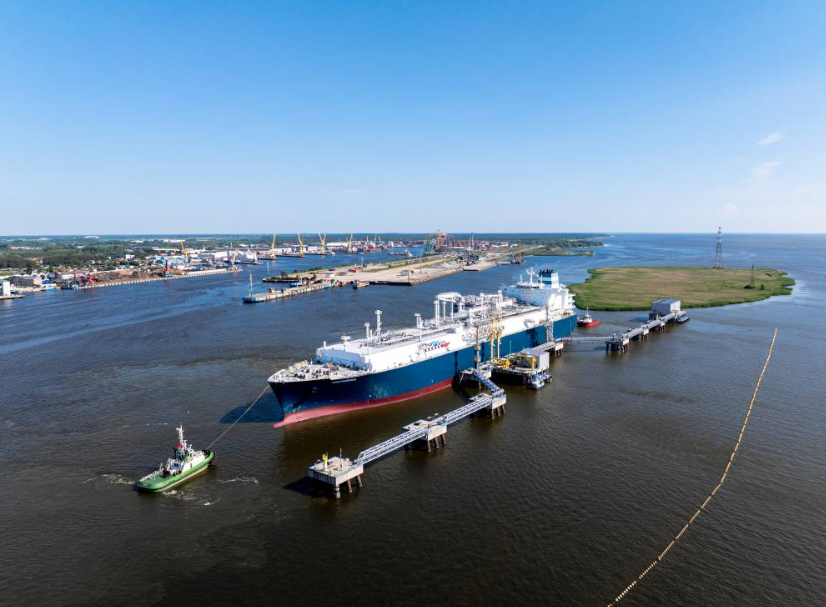
Firms have booked the majority of regasification capacity at the FSRU-based LNG import facility in Klaipeda for 2027, according to Lithuanian LNG terminal operator KN Energies.
KN announced on Thursday via its social media that the annual capacity allocation procedure for the Klaipėda LNG terminal had been completed.
“The majority of the offered 2027 regasification capacity has been booked – reflecting sustained market demand and the importance of reliable access to LNG infrastructure in the region,” the state-owned firm said.
KN did not provide further details regarding the capacity bookings.
“The remaining capacity will be addressed later this year in accordance with the terminal regulations,” it said.
Last month, the LNG terminal operator launched the regasification capacity allocation procedure for 2027.
KN offered up to 5 TWh of LNG terminal regasification capacity for gas year 2027.
This equals five conventional cargoes, each consisting of not less than 1 TWh of natural gas expressed in energy units.
The preliminary delivery windows are February 23–24, March 12-13, May 28-29, September 21-22, and October 25-26.
Finland’s Gasum, Ukraine’s Naftogaz, Lithuania’s Ignitis, Latvia’s Latvenergo, and Norway’s Equinor recently booked long-term regasification capacities at the KN Energies-operated FSRU-based LNG import facility for the period of 2033–2044.
During the procedure, the majority of the offered capacities were allocated – more than 20 terawatt-hours (TWh): 8 TWh until 2044 inclusive and a further 12 TWh until 2040, according to KN.
In December 2024, KN Energies assumed ownership of the 170,000-cbm FSRU Independence from Hoegh Evi, and the unit was registered under the Lithuanian flag.
In March last year, the FSRU completed its 500th ship-to-ship LNG transfer in Klaipeda since the start of operations in 2014.
The majority of LNG volumes originate from Norway and the United States, but the Klaipeda FSRU-based facility has also received LNG from Nigeria, Trinidad and Tobago, Egypt, Algeria, and other countries.