
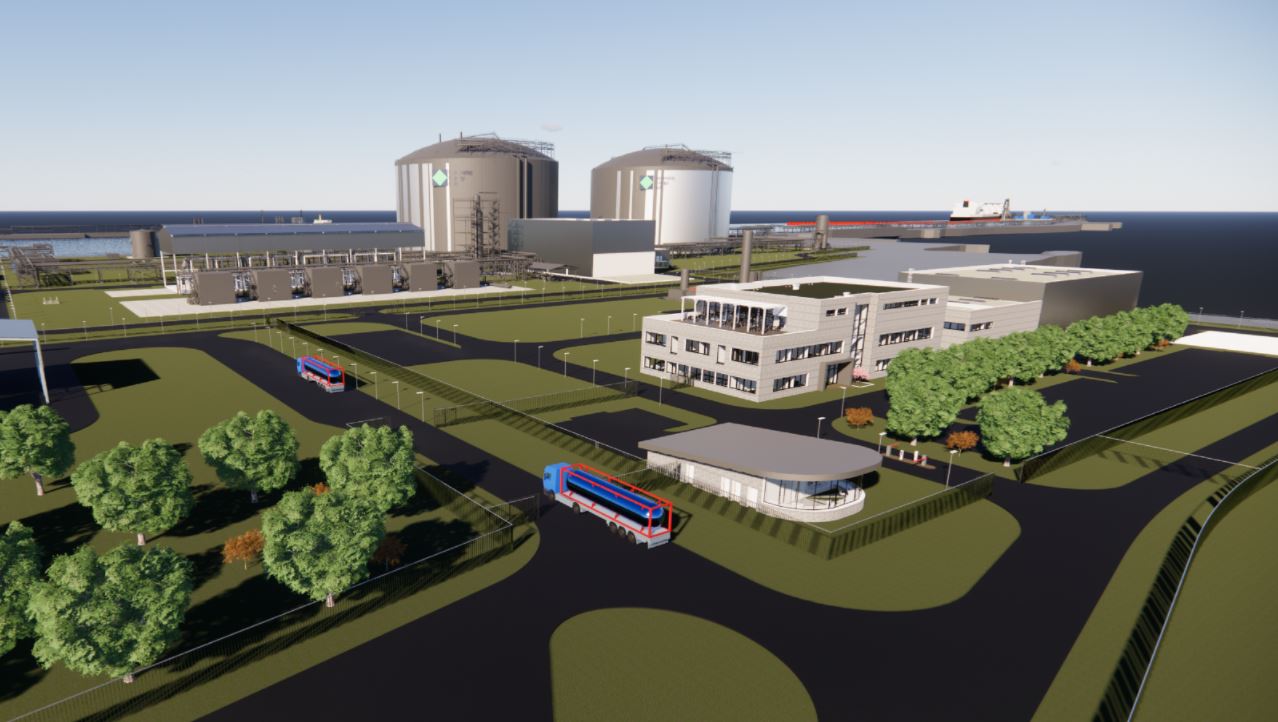
US chemical firm Dow said it has bought a minority stake in Germany’s Hanseatic Energy Hub, the developer of the Stade LNG import terminal near Hamburg.
Dow said in a statement it has signed a definitive agreement to take a minority stake in HEH and is working with the latter’s shareholders to advance Germany’s capabilities to import supplies of LNG, bio-LNG and synthetic natural gas.
The firm did not reveal the details of the stake purchase.
Current HEH partners include Germany’s Buss Group, Switzerland’s Partners Group, and Belgium’s Fluxys.
The partners plan to build the LNG import terminal on Dow’s Stade industrial park.
Dow is contributing the land for the construction of the terminal as well as infrastructure services, off-gas heat, site services and mutual harbor use rights, it said.
FID by 2023
With a projected regasification capacity of 13.3 bcm of natural gas per year, the import terminal supports the recent deal between the European Commission and the US on European energy security by satisfying up to 15 percent of Germany’s current natural gas demand, Dow said.
The agreement would also allow the US to meet nearly 25 percent of its goal to export 50 bcm of natural gas annually to Europe by 2030, Dow said.
Additionally, Dow said the terminal would repurpose off-gas heat at the Dow site for the carbon emissions-free regasification of the liquefied gas back to its gaseous state.
Dow added the project remains subject to a final investment decision, which is expected by 2023.
Capacity interest
HEH previously said the terminal would have a capacity of 12 bcm per year.
It said on Monday that market players have shown “great interest” to book capacity at the planned facility.
Last month, HEH invited international market participants to express their interest in booking long-term capacity in Stade from 2026 as it looks to accelerate the realization of the LNG import terminal.
The JV also received approval from the local government for the planned Stade facility and signed a memorandum of understanding with German energy firm EnBW for capacity booking.
As the next step, HEH is planning to submit the permit documents for the terminal and port.
Germany currently has no large LNG import terminals but there are several facilities on the table including proposals from German LNG Terminal and Uniper, which received backing by the government.
Uniper and RWE are also finalizing talks to secure three floating storage and regasification units (FSRUs) for Germany as the country looks to slash dependence on Russian gas.