This story requires a subscription
This includes a single user license.
Mercuria and Motor Oil Hellas announced the memorandum in a joint statement on Monday, establishing a framework for long-term cooperation in the LNG import project.
Under the MoU, the parties have worked on step-by-step cooperation regarding regasification capacity reservation at the terminal, the long-term supply of LNG by Mercuria to Motor Oil for delivery through the Dioriga Gas FSRU, and the joint development of the framework required to bring the project to commercial operation.
“This cooperation reflects a shared commitment to support energy security in Europe and to invest in the infrastructure that underpins a reliable and diversified gas supply,” the statement said.
“Both parties look forward to working together to advance this important addition to the region’s LNG import capacity,” they said.
The partners said that the project “stands as the most advanced and mature FSRU project in Greece.”
Strategically located in the Saronic Gulf, it represents the “optimal solution for LNG imports into Greece and the wider Southeast European region.”
Project development
The FSRU-based facility has been in development for years.
In 2023, the project was characterized as a “strategic investment” by the Greek government.
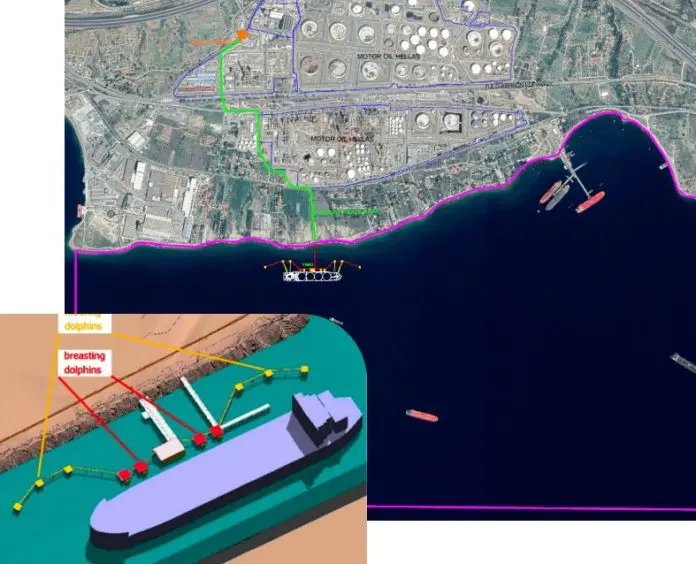
The terminal will be located about 70 km away from Athens, in the area “Agioi Theodori” of the regional district of Corinth, near Motor Oil’s refinery, and at a distance of about 1.5–2 km from the national natural gas system.
According to the Dioriga Gas website, the project “brings 21-24 TWh of LNG imports (30 percent of the Greek market) and additional storage of 177,000 cbm in Southern Greece (+45 percent).”
Dirioga Gas said in a May 8 status update that the project has already offered its capacity through a market test with “strong participants.”
“Moreover, it is highlighted that this project comes at a time when Greece is enhancing its role as a regional LNG hub, covering 2 – 6 bcma (2 only Greece and 6 with exports) deficit after the full phase‑out of Russian gas from 2027 onwards,” the LNG terminal developer said.
Dioriga Gas said its project team is currently working towards “obtaining a sea license, third-party exemption from RAAEY, and is in negotiations with important LNG market participants to join the existing project stakeholders.”
Greece mostly imports US LNG
LNG deliveries to DESFA’s Revithoussa LNG terminal and Gastrade’s Alexandroupolis FSRU-based facility in Greece rose in the first quarter of this year, with the US supplying the majority of the volumes.
The Greek gas grid and Revithoussa LNG terminal operator, DESFA, said that LNG shipments totaled 14.90 TWh during the first quarter.
This marks a 36 percent increase compared to 10.96 TWh in the corresponding period of 2025, with Revithoussa serving as the main entry point, accounting for 11.44 TWh, or approximately 43 percent of total imports.
At the same time, the Alexandroupolis FSRU significantly increased its contribution, covering approximately 13 percent with 3.46 TWh, DESFA said.
DESFA said the US remained the leading LNG supplier to Greece, with 7.60 TWh, accounting for approximately 66 percent of total LNG imports, followed by Nigeria with 3.02 TWh.
Mercuria also trades US LNG volumes and it recently agreed to buy more LNG from Kimmeridge’s Commonwealth LNG, the developer of the 9.5 mtpa LNG export project near Cameron, Louisiana.
Mercuria agreed to buy approximately 1.5 million tonnes per annum from the project, which just took a final investment decision.