This story requires a subscription
This includes a single user license.
The application requests authorization to export up to 1,293.75 billion cubic feet per year (Bcf/yr) of natural gas, equivalent to approximately 25 million tonnes per annum (mtpa) of LNG, Argent LNG said on Wednesday.
The LNG would be produced and exported from the Argent LNG terminal that the company proposes to construct, own, and operate at Port Fourchon, one of the most strategically important energy logistics hubs on the US Gulf Coast.
Argent LNG is seeking a 20-year export authorization, consistent with the DOE policy, beginning from the commencement of commercial operations at the proposed facility.
The request also includes a three-year make-up period following the authorization term to ensure the full delivery of contracted LNG volumes.
“At a time of growing geopolitical uncertainty and volatility in global energy markets, it is essential that the United States continue expanding reliable sources of LNG supply for the world,” said Jonathan Bass, Chairman and CEO of Argent LNG.
“Energy security is national security. By increasing America’s capacity to deliver LNG to global markets, projects like Argent LNG help provide stable and diversified energy supplies to allies and partners who depend on dependable access to natural gas,” Bass said.
12 modular liquefaction units
According to the application, the project will be constructed on an approximately 900-acre parcel at Port Fourchon in Lafourche Parish, Louisiana, adjacent to Belle Pass and Bayou Lafourche.
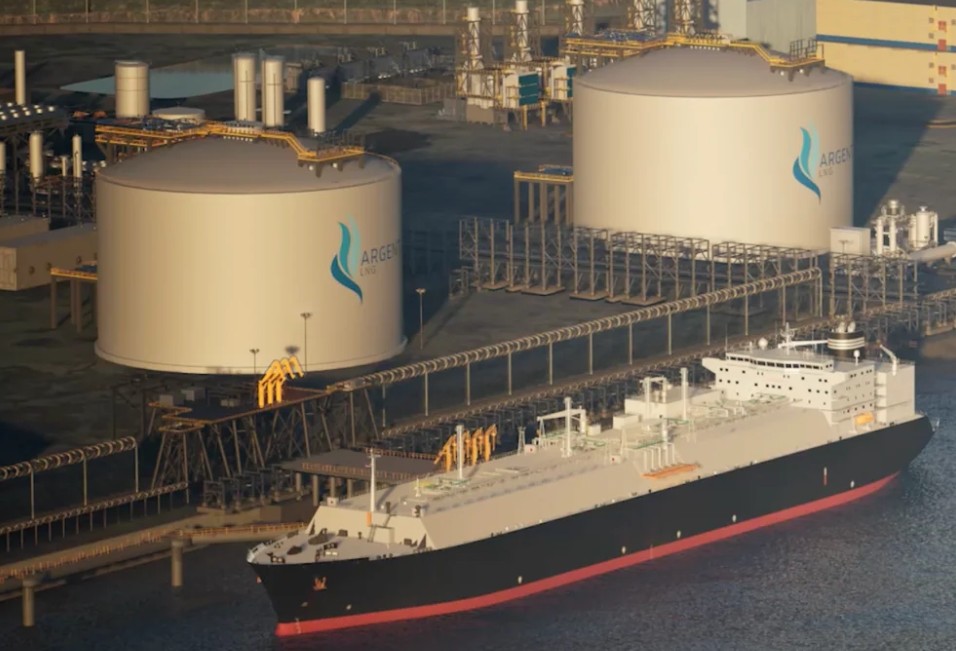
The LNG project would consist of pre-treatment facilities, 12 modular liquefaction units, and two full-containment membrane 220,000-cbm LNG storage tanks, featuring GTT’s technology.
It would also include an approximately 350-MW simple-cycle gas turbine power generation facility, two LNG marine loading berths capable of accommodating LNG carriers generally ranging from 125,000 to 260,000 cbm of cargo capacity, as well as smaller LNG bunkering vessels, and other appurtenant facilities.
The Argent LNG Project anticipates receiving feedgas via approximately 0.7 miles of new
dual 16-inch-diameter pipelines interconnecting with the existing Kinetica interstate natural gas
pipeline system, as well as other interstate and intrastate pipeline systems in the vicinity of the LNG Project.
By design, the project is not dependent upon any particular natural gas supply source and will have access, through the interconnected pipeline grid, to a wide variety of supply sources and production areas, it said.
2030
Argent LNG currently anticipates commencing construction in December 2027, with service anticipated to begin in the first quarter of 2030.
The firm has not yet entered into any binding contracts with customers for the export of LNG from the project.
However, Argent LNG has signed a non-binding heads of agreement with the government of Bangladesh for up to 5 mtpa of long-term US LNG supply, and a strategic cooperation agreement with EPIAS, Türkiye’s gas and electricity exchange.
“Likewise, more agreements are under discussion with governments and utilities across Eastern Europe, Southeast Asia, and Latin America,” Argent LNG said.
In October last year, the US (FERC) officially accepted Argent LNG’s export terminal at Port Fourchon into the pre-filing process.
Argent LNG said at the time that the facility would have an initial capacity of up to 12 mtpa, with an estimated cost of about $10 billion.
The company plans to use Honeywell’s pretreatment solutions.
In addition, Argent LNG selected Baker Hughes as the liquefaction solution and related services provider for the planned LNG export terminal in Port Fourchon, and it selected LNG equipment maker Chart Industries to supply its mid-scale modular liquefaction solution.